
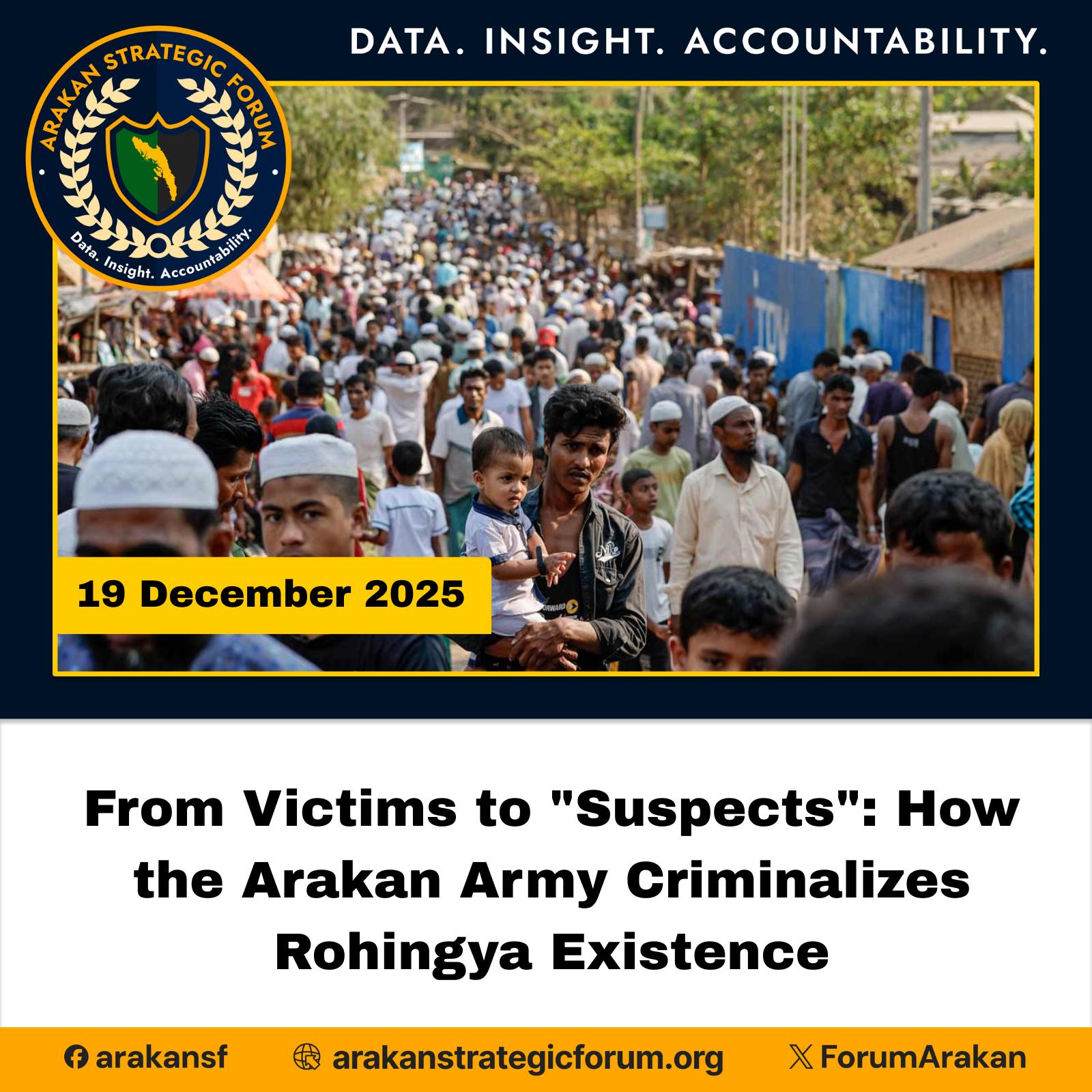
Across northern Arakan (Rakhine), the Arakan Army (AA) is actively reshaping how the Rohingya are seen, spoken about, and treated through a calculated discourse that transforms a persecuted, stateless people into permanent “suspects.” This shift is neither accidental nor rhetorical. It is a deliberate strategy to legitimize coercion, forced labor, displacement, and exclusion under the language of “security.” For decades, the Rohingya have been victims of structural violence, mass displacement, and discriminatory state policies.
Yet today, the AA recasts this same community as a threat accusing Rohingya civilians of collaboration, disloyalty, criminal intent, or demographic danger. This narrative inversion is central to how abuse is normalized. AA messaging delivered through local commanders, checkpoints, village announcements, and online propaganda follows a consistent pattern: Rohingya mobility is framed as suspicious, their poverty as deceitful, their labor as unreliable, and their attempts to flee as evidence of guilt. In this framing, Rohingya are no longer a community in crisis, but a population to be policed.
On the ground, words become force. In northern Maungdaw, an AA commander ordered 50 Rohingya workers from each village every single day, even during harvest season, dismissing hardship and warning that families who refuse “must leave the country.” Once a community is portrayed as suspicious or unwanted, such threats become enforceable. This rhetoric pushes Rohingya into impossible choices. Those escaping forced labor or heavy taxation are told they “have something to hide,” while smuggling networks exploit their desperation charging 800,000 to 1.25 million kyat per person (USD 380–595) for dangerous crossings into Bangladesh.
Families seeking safety are then branded as criminals by the very armed group that drove them out. The consequences spill beyond Arakan. On 25 November, Bangladesh Coast Guard and police rescued 28 people including women and children being smuggled by sea toward Malaysia. These cases are not isolated; they reveal a collapsing protection environment inside Arakan that the AA’s narrative conveniently conceals. By labeling Rohingya as “suspects,” the Arakan Army grants itself license for collective punishment: movement restrictions, blocked access to food, farming and fishing bans, fabricated complaints leading to home seizures, forced labor of children, and survival conditioned on AA permission.
In this system, a Rohingya is not treated as a resident or a rights-holder, but as a problem to be managed. The purpose is domination. Dehumanization allows abuse to be rebranded as administration forced labor as “discipline,” movement bans as “monitoring,” and property seizure as “procedure.” It also serves AA’s broader ambitions: depopulated, terrorized villages reduce resistance and open space for supply routes, military positions, and economic corridors.
The Rohingya are not suspects. They are civilians trapped between violence, statelessness, and erasure. As long as AA discourse continues to portray them as inherently dangerous or disloyal, their vulnerability will deepen, and accountability will remain out of reach. Dehumanization here is not a by-product of conflict, it is a weapon, deliberately used to justify suffering and entrench control in northern Arakan.