
The Arakan Army, Rohingya Trafficking and Demographic Control in Arakan State
The latest reported loss of a Rohingya vessel near the Ayeyarwady coast cannot be understood as an isolated maritime accident. It forms part of a broader pattern in which persecution on land, organised trafficking and mass death at sea increasingly appear connected.
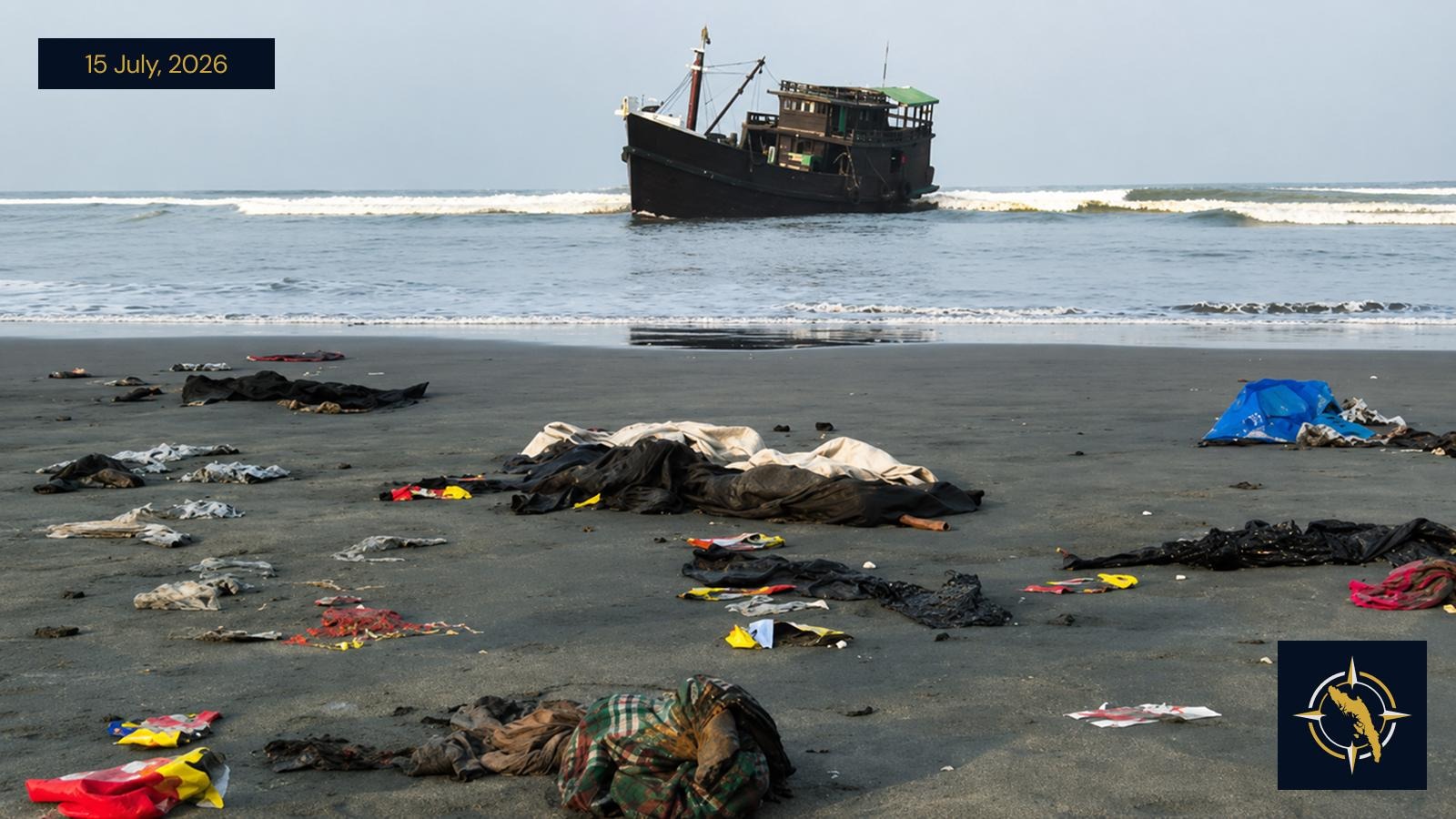
According to local accounts, a trawler carrying approximately 280 Rohingya left Sintet Maw village in Pauktaw Township on 29 June 2026, bound for Thailand and Malaysia. It reportedly sank near the Ayeyarwady coast on 8 July. Fishermen from areas around Ayeyarwady, Ye and Mawlamyine subsequently recovered several bodies from the sea.
The passengers reportedly came from Maungdaw, Buthidaung, Rathedaung, Sittwe, Kyauktaw, Mrauk-U, Minbya, Thet Kel Pyin and Bume Ward. Their identities and the final casualty figure have not yet been independently confirmed, and no complete passenger list has been made public.
The incident is particularly disturbing because it was reportedly the second major sinking linked to Sintet Maw within approximately one week. Shortly before this vessel departed, another boat carrying an estimated 250 Rohingya was reported to have capsized near the same area. If the accounts are substantially accurate, more than 500 Rohingya may have been lost within days.
A Controlled Coastline
The Arakan Army and its political wing, the United League of Arakan, now exercise effective control over most of Rakhine State, including Pauktaw and extensive sections of the coastline. They regulate civilian movement, operate checkpoints, collect taxes, mobilise labour and maintain local administrative and intelligence networks.
Rohingya residents have reported that routine travel between villages may require permission and that movement for farming, fishing, employment or healthcare can result in questioning, payment or detention. Yet trafficking networks appear capable of gathering hundreds of people from several townships, transporting them through controlled territory and placing them aboard vessels from monitored coastal areas.
Such an operation requires organisation. Passengers must be recruited, assembled and sheltered. Vehicles or smaller boats must move them towards the coast. Fuel, food, crews and vessels must be arranged. Payments must be collected, and brokers must communicate with contacts in Myanmar, Thailand and Malaysia.
Hundreds of people do not reach a militarily controlled departure point without leaving a visible operational trail.
Either the network repeatedly escaped an authority capable of closely monitoring ordinary civilian movement, or elements within that system tolerated, protected, taxed or assisted the departures. The available evidence does not yet determine which explanation is correct. But simple ignorance is increasingly difficult to accept.
The Alleged Trafficking Network
Local sources identify a man known as Maung Ni as an important recruitment intermediary connected to the latest voyage. He is alleged to have operated as a local agent able to arrange movement through AA-controlled territory and onward passage towards Thailand and Malaysia.
The same sources allege that the network benefited from connections within the AA administration. They have named Kyaw Kyaw Kyun, described in those accounts as a senior figure associated with the Ponnagyun office.
These are serious allegations and require independent verification. The identities, official positions and precise involvement of the individuals concerned should be examined through survivor testimony, financial records, communications data and command-level investigation. At present, the claims should be treated as investigative leads rather than established findings.
Nevertheless, the absence of formal documents does not make the allegations irrelevant. Trafficking networks operating inside conflict zones rarely leave written instructions. They function through personal relationships, cash payments, protection arrangements, checkpoint access and fragmented responsibility.
According to local accounts, passengers were recruited through promises of safety, employment and a better future. Others were allegedly pressured through threats of arrest, armed intimidation or fear of further persecution.
The organisers reportedly planned to demand between 10 million and 12 million kyat from each passenger after arrival in Thailand. For a vessel carrying 280 people, the potential value of the operation would have reached several billion kyat.
This illustrates the political economy of the journey. A Rohingya passenger becomes a source of income at multiple stages: recruitment, transport, checkpoint passage, accommodation, embarkation, transit, ransom and final delivery. Relatives abroad may be forced to finance the journey or pay for the passenger’s release.
The victim is therefore converted into both a displaced person and a financial asset.
A Voyage into Known Danger
Local sources further allege that the vessel was overloaded and sent to sea despite dangerous weather conditions. If confirmed, this would move the incident beyond ordinary negligence.
An organiser who knowingly places hundreds of people on an unseaworthy vessel during severe weather accepts an obvious probability of mass death. Whether the intention was specifically to drown the passengers may be difficult to prove. But the risk would have been neither hidden nor unforeseeable.
The sea also provides an effective layer of deniability. Bodies disappear, passenger lists remain incomplete and survivors may be scattered, detained or unable to speak. Responsibility can then be transferred to storms, mechanical failure or criminal brokers, while the structures that enabled the departure remain beyond scrutiny.
The final cause of death may be drowning. The chain of responsibility lay with AA.
The System Producing the Passengers
Human-rights reporting has documented restrictions on movement, farming, fishing, employment and access to markets. Rohingya communities have also reported forced labour, arbitrary taxation, detention, confiscation of land and property, and punishment imposed without transparent legal process.
These practices create a predictable sequence.
First, movement restrictions isolate communities and prevent lawful economic activity.
Second, taxes, fines, forced labour and confiscation gradually destroy household resilience.
Third, insecurity and the absence of credible accountability convince families that their future is no longer protected.
Finally, trafficking networks offer illegal departure as one of the few remaining routes of escape.
This is not voluntary migration in any meaningful sense. It is displacement produced through the systematic destruction of alternatives.
The strongest allegation, that AA leaders centrally direct trafficking operations. A second possibility is that local commanders, officials or checkpoint personnel facilitate departures or accept payments. This requires urgent investigation.
The third conclusion is already supported by substantial evidence: the governing environment under AA control is creating the desperation that supplies the trafficking economy.
Demographic Consequences
Every family that leaves weakens the Rohingya presence in its village. Every abandoned home or field becomes easier to confiscate or redistribute. Every death removes a future claimant to land, citizenship and political representation. Every displaced witness reduces the likelihood that abuses will later be documented.
Reports that Rohingya have been forced to construct settlements for other communities on confiscated Rohingya land are therefore especially significant. They suggest that displacement may be followed by physical restructuring intended to make return increasingly difficult.
The process offers several advantages to those exercising territorial power. It reduces a population often treated as politically suspect, weakens future land claims, removes witnesses, generates revenue for trafficking and protection networks, and transfers the humanitarian burden to Bangladesh and Southeast Asian states.
A mass expulsion would draw immediate international condemnation. A slower process of restriction, impoverishment, trafficking and maritime death is less visible and easier to deny. The demographic result may ultimately be the same.
Conclusion
The reported loss of two vessels carrying more than 500 Rohingya demands an investigation extending far beyond the boat operators.
Investigators must establish who recruited the passengers, collected the money, controlled the routes, operated the checkpoints and supervised the departure areas. They must examine communications records, financial transfers, survivor accounts and the relevant AA command structures in Pauktaw and surrounding areas.
The precise involvement of individual officials remains to be proven. But the broader pattern is increasingly difficult to conceal.
Rohingya are restricted on land, deprived of livelihoods and exposed to a trafficking economy operating through territory controlled by an authority that monitors almost every other aspect of their lives. Brokers profit from their departure. Land becomes available after they leave. Humanitarian responsibility is transferred abroad. The bodies are recovered far from the point where the process began.
The decisive question is no longer simply whether the Arakan Army ordered a particular vessel to sail. It is how hundreds of Rohingya could repeatedly pass through AA-controlled territory, board overloaded vessels and enter dangerous waters while the authority controlling the coastline saw nothing, prevented nothing and accepted no responsibility.