The Strategic Reframing of Perpetrators as Partners
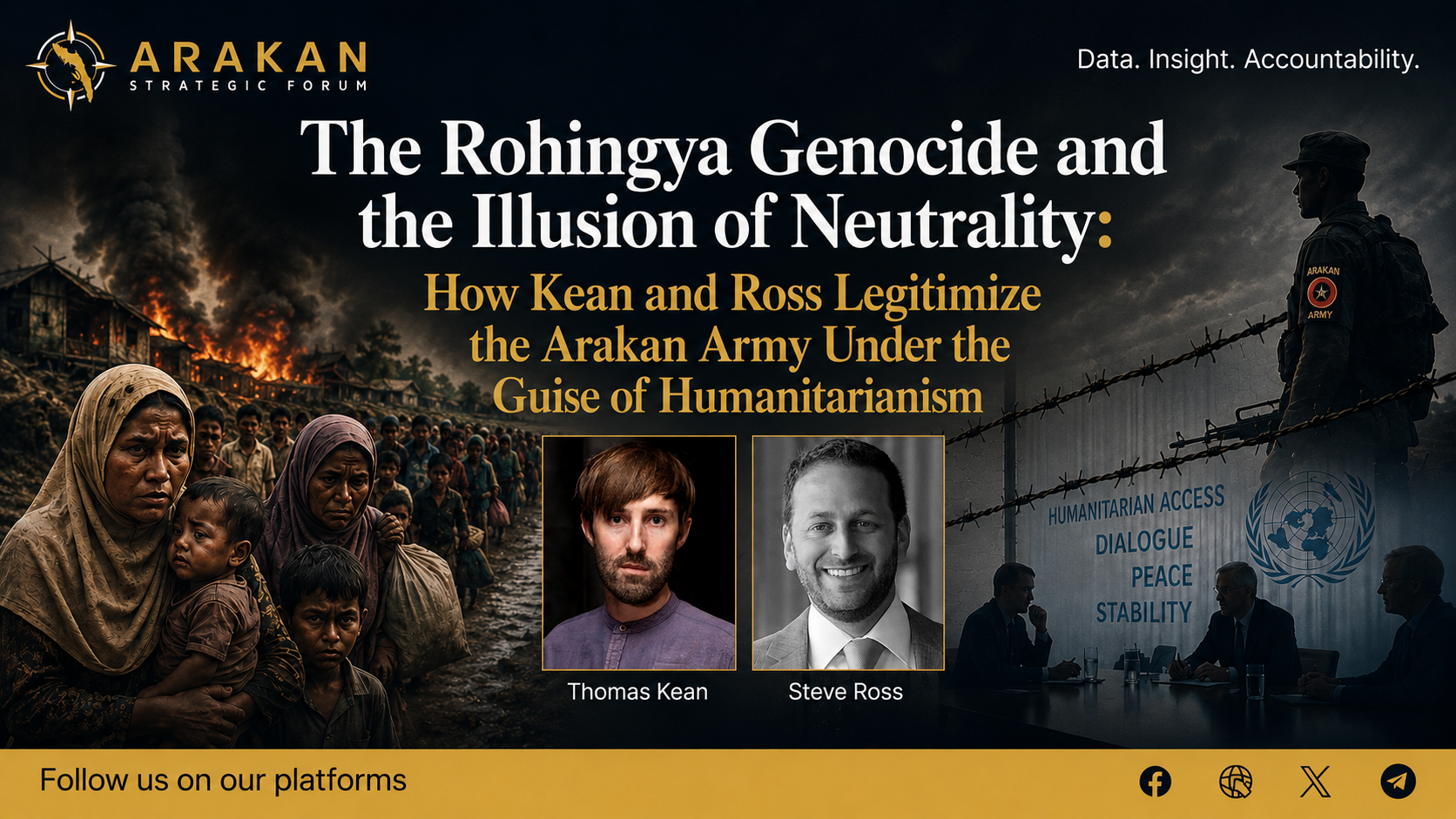
Thomas Kean of the International Crisis Group and Steve Ross of the Stimson Center present themselves as neutral policy analysts, yet their writings reveal a disturbing pattern of advocacy that systematically privileges the political legitimization of the Arakan Army while sidelining the grave human rights violations perpetrated against the Rohingya population. Their framing of this armed group as an indispensable partner in any future repatriation framework represents a fundamental betrayal of the principles of justice and accountability that should inform any serious engagement with the Rohingya crisis.
In August 2022, Kean advised Bangladesh to consider engagement with the Arakan Army as a prerequisite for large-scale repatriation, arguing that any return of Rohingya refugees would require the group’s support. Similarly, Ross’s 2024 analysis positioned the Arakan Army as essential to addressing border security concerns, implicitly treating them as a necessary partner in regional stability.
This framing is profoundly disconcerting when juxtaposed against the documented atrocities attributed to the Arakan Army, including the May 2024 massacre in Buthidaung Township where approximately 600 Rohingya men, women, and children were systematically targeted through indiscriminate shooting, electrocution torture, and the burning of entire villages.
The Discourse of Legitimization Through Language
One of the most insidious aspects of Kean and Ross’s analysis is their strategic deployment of language. Kean employs terms such as “non-state partner,” “proto-state,” and “de facto authority,” while Ross favours phrases like “security management,” “border stability,” and “effective partner.”
These lexical choices constitute a calculated effort to gradually reframe the Arakan Army’s status from an insurgent group implicated in grave crimes to a legitimate governing entity worthy of international recognition. When analysts of this calibre employ such terminology, they lend credibility to an organization whose actions belie any claim to legitimate governance, rendering the suffering of Rohingya communities invisible through the sanitized language of policy analysis.
The dual role of Thomas Kean as both an International Crisis Group Senior Consultant and a Director and Editor-at-Large of Frontier Myanmar, in which he holds a 7% ownership stake, introduces additional layers of concern regarding potential conflicts of interest. While there is no evidence of direct malfeasance, the appearance of conflicting interests remains problematic in an area where human lives are at stake.
Furthermore, the documented connection between the Arakan Army and the narcotics trade raises profoundly uncomfortable questions about whether these analysts’ advocacy serves the interests of justice or inadvertently provides cover for an entity whose operations are sustained by criminal economies.
The Bloody Reality of Six Months of Atrocity
Between January and June 2026, a period of just six months, the Arakan Army’s campaign of violence reached alarming proportions. Eighty-three Rohingya lost their lives, including 42 men, 41 women, and 19 children. A further 187 individuals sustained injuries, among them 34 children. The group engaged in systematic destruction of civilian infrastructure, demolishing 229 homes, 83 shops, schools, healthcare facilities, and mosques, while banning the Islamic call to prayer and forcibly displacing entire communities.
This grim catalogue of crimes would, under any consistent application of international justice principles, warrant immediate condemnation and accountability measures. Yet Kean speculates that “there was a potential that under the Arakan Army conditions might have improved compared to how the Rohingya have been treated in the past,” while Ross treats border security as a technical problem requiring the group’s cooperation, sidestepping the fundamental impossibility of a perpetrator guaranteeing the safe return of those they have systematically persecuted.
The Double Standard of Moral Outrage
Perhaps the most telling indicator of bias is the stark contrast between how these analysts treat different actors in Myanmar’s conflict. Both readily condemn the military junta’s atrocities and demand accountability when the violence is perpetrated by Myanmar’s armed forces. Yet when identical crimes are committed under the Arakan Army’s flag, the language shifts to one of “local governance,” “ethnic resistance,” and “pragmatic necessity.”
This asymmetry reveals a fundamental inconsistency: atrocity appears to be judged not by its nature but by its perpetrator. The Rohingya, who have been subjected to horrors at the hands of both the military and the Arakan Army, are entitled to consistent application of justice principles, not to a selective moral calculus that excuses one perpetrator while condemning another.
Conclusion: The Moral Failure of Pragmatism Without Accountability
The call for Bangladesh to engage with the Arakan Army as a pragmatic necessity places the government in an impossible position, demanding consideration of all avenues while creating moral and legal complications that cannot be dismissed as mere realism.
When Kean and Ross advocate for “realistic goals” in repatriation policy without addressing the fundamental obstacle that the Rohingya cannot safely return to territories controlled by those who have brutalized them, they risk creating a framework in which Rohingya rights become negotiable, their safety contingent on the goodwill of perpetrators, and their dignity secondary to geopolitical considerations. This is not realism; it is resignation to a reality in which justice is sacrificed for convenience.
The Rohingya, whose suffering has been documented in excruciating detail, deserve analysts who will speak truth to power, not those who will provide intellectual cover for perpetrators. The international community deserves policy recommendations grounded in justice, not expediency.
Any discussion of the Rohingya future must ultimately confront the fundamental question of whether repatriation can truly be safe and sustainable without first ensuring justice, security, rights, and dignity for this persecuted population. Until that question receives an unequivocal affirmative answer, engagement without accountability remains collaboration with impunity, and that is a position no honest analyst should advance.