
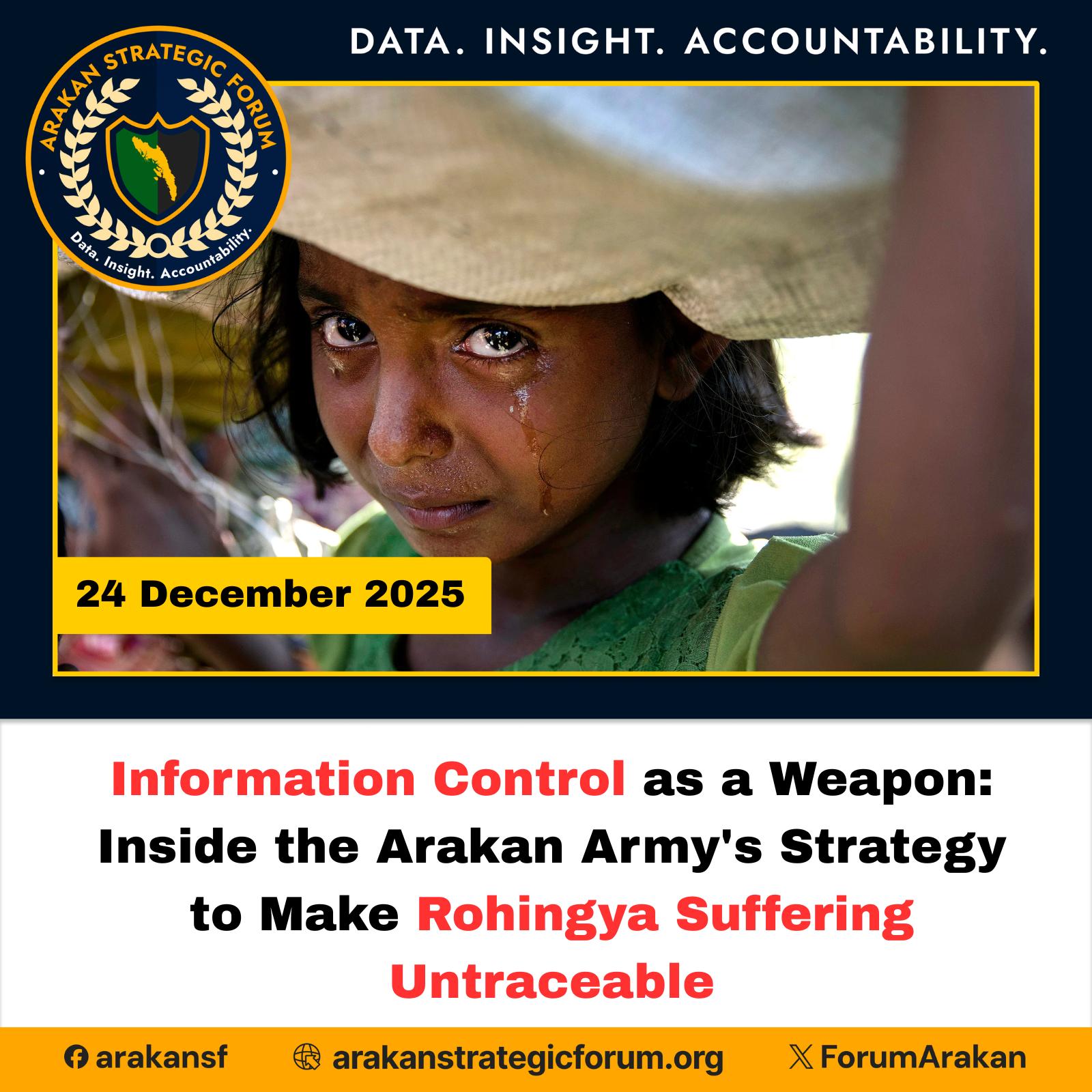
In northern Arakan, the Arakan Army (AA) has moved beyond territorial contestation into the systematic management of civilian life. Central to this control is a discursive shift that reframes Rohingya Muslims not as civilians living under armed authority, but as inherent security risks. Through this narrative transformation, a persecuted and stateless population is recast as a population of “suspects,” enabling coercion, exclusion, and collective punishment to be exercised under the language of order and vigilance.
This reframing is deliberate and strategic. The Rohingya are not targeted because of individual conduct, but because their existence is portrayed as inherently questionable. AA messaging delivered through village-level administrators, checkpoint interrogations, compulsory meetings, and informal announcements consistently suggests that Rohingya movement signals disloyalty, that requests for aid conceal ulterior motives, and that efforts to flee reflect guilt rather than fear. In this framework, Rohingya Muslims are no longer understood as people navigating crisis, but as bodies to be monitored and contained.
Once suspicion becomes the default lens, control becomes easier to justify. Restrictions on farming and fishing are presented as “security measures.” Forced labor is reframed as “community duty.” Arbitrary taxation is described as “administrative contribution.” Families that resist or attempt to leave are accused of hiding connections, collaborating with hostile actors, or undermining stability. The burden of proof is inverted: innocence is never presumed, and survival itself becomes conditional on compliance.
On the ground, discourse translates directly into harm. In parts of Maungdaw and Buthidaung townships, Rohingya communities report routine demands for daily labor quotas regardless of age, health, or agricultural season, accompanied by threats of expulsion for noncompliance. Forced labor includes portering, construction, and other unpaid work carried out under threat and intimidation. Children are compelled to perform labor tasks under the same logic of “discipline.” Households that complain or fail to meet expectations face fabricated allegations that lead to land confiscation or eviction. Each act is administratively framed, masking its coercive and unlawful nature.
This environment produces predictable outcomes. As restrictions tighten and livelihoods collapse, Rohingya families seek escape through dangerous routes. Smuggling networks capitalize on this desperation, charging exorbitant sums for crossings into Bangladesh or onward journeys by sea. Those who flee are then retroactively labeled criminals, reinforcing the narrative that justified their treatment in the first place. The cycle is self-sustaining: abuse generates flight, flight is cited as evidence of guilt, and guilt legitimizes further abuse.
The function of this discourse is not merely exclusion, but domination. By stripping Rohingya Muslims of civilian status and recoding them as perpetual suspects, the Arakan Army reduces moral and political barriers to control. Depopulated and intimidated villages are easier to manage, supply corridors are secured, and resistance is minimized without the visibility of overt mass violence. Dehumanization becomes governance.
Rohingya Muslims are not suspects. They are civilians subjected to an armed authority that uses language as a weapon to rationalize suffering and entrench power. As long as this discursive framework remains unchallenged, abuses will continue to be normalized, accountability will remain elusive, and the erasure of Rohingya life in northern Arakan will proceed under the cover of “security.”