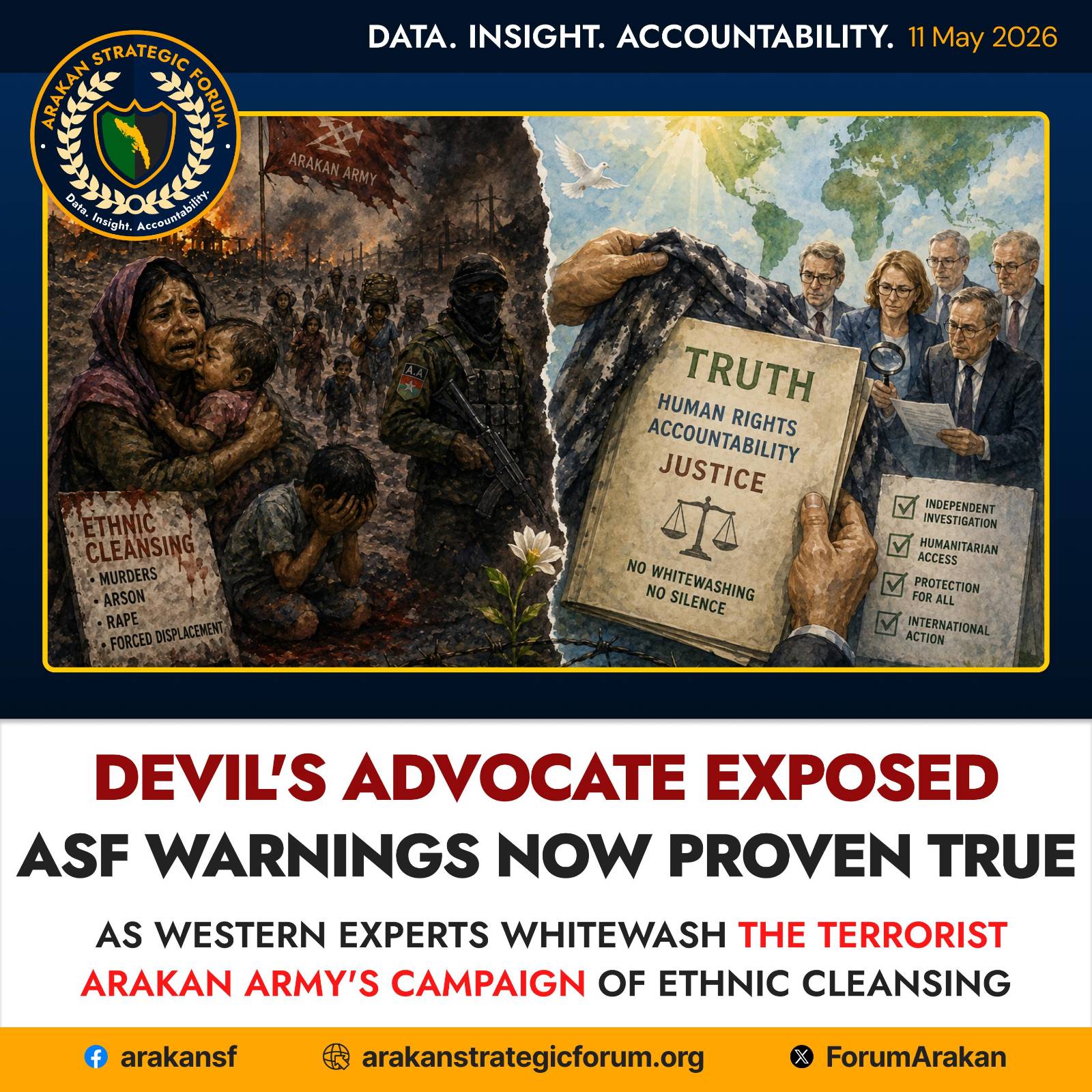
Six months after the Arakan Strategic Forum (ASF) published its searing October 2025 report branding them the “Devil’s Advocates of Terrorist AA,” the same Western policy analysts find themselves under renewed scrutiny. Their confident predictions of “pragmatic engagement” with the Arakan Army now sound uncomfortably out of step with the fresh evidence of displacement and suffering coming out of Arakan (Rakhine) State.
In April 2026, Steve Ross, Senior Fellow at the Stimson Center and a longtime voice on Myanmar’s Rakhine crisis, declared in a widely circulated interview that the Myanmar military “will not be able to come back to Arakan.” The AA, he argued, is now too deeply entrenched, protected by the formidable geography of the Rakhine Yoma mountains, and backed by widespread local hostility toward the junta.
For those who understand the ground reality of Arakan (Rakhine), this was not neutral analysis. It was the ASF’s starkest warning playing out in real time: a network of self-described humanitarian pragmatists appears to be giving intellectual and political cover to a brutal armed terrorist-mafia group as it carries out what many describe as the slow-motion erasure of the Rohingya from their ancestral lands.
The Human Cost: Over 150,000 Fresh Displacements Since Late 2023
According to United Nations data, more than 150,000 Rohingya have fled Rakhine State into Bangladesh since November 2023 — the largest single exodus since the 2017 genocide. In 2025 alone, nearly 900 Rohingya died or went missing at sea, making it the deadliest year on record for maritime movements out of Myanmar.
But the real scale of the tragedy is far more harrowing. Independent estimates from Rohingya organisations and community monitors put the true figure at over 220,000 people displaced from Arakan. Between 6,000 and 7,000 Rohingya are believed to have been killed or died as a direct result of the violence and hardship, while another 3,000 to 4,000 were forced onto the perilous sea route toward Malaysia or Indonesia.
Independent investigations by Human Rights Watch, Fortify Rights, Amnesty International, and the UN Office of the High Commissioner for Human Rights describe an even darker reality under Arakan Army dominance:
- Mass killings and arbitrary executions, including large-scale incidents in areas under AA control.
- Widespread forced labour and conscription, with Rohingya men, women and children forced at gunpoint to serve as porters, human shields and night guards.
- Systematic extortion, rebranded by the AA as “administration fees” and “taxation.”
- Village burnings, land seizures, and the resettlement of Rakhine civilians into former Rohingya areas — a pattern many observers call demographic engineering.
- Severe restrictions on movement, agriculture and basic survival that amount to collective punishment.
The UN has been unequivocal: once the Arakan Army seized control of northern Rakhine, it became “the main perpetrator of human rights abuses against the Rohingya.”
Yet Steve Ross and fellow “realists” continue to present AA rule as an inevitable and stable fact of life, effectively handing the group the international legitimacy it seeks while another generation of Rohingya is driven into exile and onto dangerous boats.
The Cost of “Pragmatism”
Rohingya organisations and the ASF argue that this approach does more than overlook the suffering. By framing engagement with the AA as the only realistic path forward, these analysts risk normalising a situation in which the very group controlling the territory continues to drive people out.
How can scholars who built their reputations condemning the Myanmar military’s 2017 genocide now speak so readily of “stability” and “refugee returns” while the AA stands accused of killings, forced labour, extortion and the physical replacement of Rohingya communities? The question lingers uncomfortably in Rohingya circles.
Global Arakan Network: A Platform with an Agenda
The interview that gave Steve Ross his latest platform adds another layer to the controversy. The Global Arakan Network (GAN) is widely regarded by Rohingya activists as a slick, English-language outlet closely aligned with AA leadership, including family connections to commander-in-chief Twan Mrat Naing. It consistently a
mplifies pro-AA narratives, challenges critics, and reframes documented abuses as isolated incidents or junta disinformation. In effect, the same outlet accused of whitewashing AA actions has become the megaphone for the very experts the ASF warned were acting as Devil’s Advocates.
When Engagement Crosses a Line
The Arakan Strategic Forum warned in October 2025 that selective morality and the desire for access would lead precisely here: to Western voices granting the AA the political cover it needs to operate with less international pressure. That warning now looks painfully prescient.
The Rohingya are not asking for theoretical discussions about realism versus idealism. They are asking why analysts who claim to care about human rights appear willing to look the other way when the perpetrator simply changes its uniform.
History will judge those who provided intellectual and political shielding for this latest chapter of displacement and loss.
Steve Ross, the Stimson Center, and every self-described pragmatist now face a clear choice: continue framing Arakan Army rule as an unchangeable reality, or speak more forcefully about the human cost unfolding on the ground.
The Rohingya have already paid that cost in blood and exile. The question the rest of the world must answer is whether it will keep looking away.