Standfirst
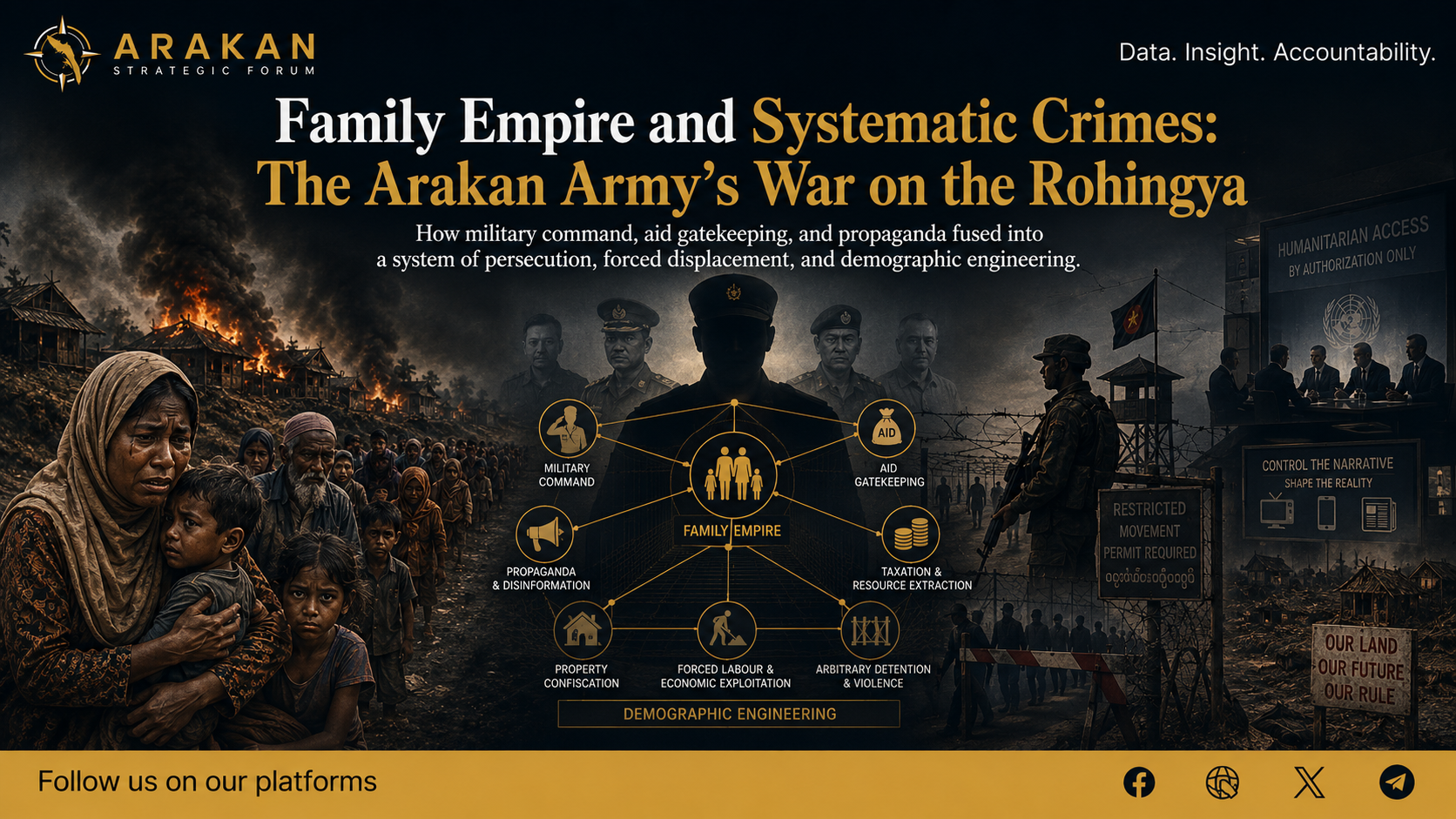
The Arakan Army (AA) is not a centralised ethnic armed group; it is a family empire that has fused military command, civil governance, humanitarian coordination, and international propaganda under a single kinship network. The consequences for the Rohingya population are not incidental hardship but systematic crimes, forced displacement, forced labour, deprivation of livelihood, and a deliberate strategy of demographic engineering designed to permanently remove Rohingya from Arakan. This case reveals that the AA’s project, far from being a liberation struggle, has become an apparatus of elimination operated for the benefit of one unaccountable ruling family.
Strategic Assessment
The AA/ULA structure under Twan Mrat Naing is a family-held corporation of violence and administration. The same narrow kinship circle that commands battalions also runs the tax system, controls humanitarian access, manages the international narrative, and decides who may live, die, move, own property, or practise their faith in territory under AA control. It is the deliberate architecture of permanent, unaccountable rule.
For the Rohingya people , this architecture produces a continuum of crimes that are not aberrations but the logical output of a system designed without any independent institution capable of restraining the family’s will. Forced labour, arbitrary detention, movement restrictions, property confiscation, and systematic economic strangulation are not isolated incidents; they are the predictable and intended result of a governance model in which the victim has no authority to appeal to that is not controlled by the perpetrator. Available evidence and consistent survivor testimony proves that these acts are widespread and systematic, meeting the legal threshold for crimes against humanity. Certain acts, forced labour and arbitrary detention of civilians in connection with an armed conflict—also constitute war crimes under international humanitarian law.
The Family Empire: Structure of Absolute Control
The concentration of authority is absolute and familial. Twan Mrat Naing holds the positions of Commander-in-Chief of the AA and supreme political authority within the United League of Arakan. There is no civilian body, judicial panel, or oversight mechanism that can overrule his decisions.
The grip extends through blood and marriage.
Aung Mrat Kyaw, heading the Global Arakan Network, manages international advocacy and propaganda, ensuring that external audiences receive a sanitised image of a democratic federal movement.
Twan Morn Naing runs the so called Humanitarian and Development Coordination Office, placing the gateway for aid and humanitarian reporting inside the family circle.
San Kyaw Hla, the father-in-law, provides intergenerational political reinforcement. No significant lever of power, military, fiscal, diplomatic, informational, or humanitarian, sits outside this network.
The result is a family empire that operates with the total fusion of executive, military, and humanitarian functions, making accountability structurally impossible and abuse inevitable.
Crimes Against Humanity and War Crimes: The Pattern
International law defines crimes against humanity as certain acts committed as part of a widespread or systematic attack against a civilian population. The acts documented by multiple community accounts in AA-controlled territory include severe deprivation of physical liberty, persecution against an identifiable group on ethnic and religious grounds, and other inhumane acts causing great suffering. The systematic nature of these acts—repeated across locations and time—is precisely what distinguishes them from isolated violations.
The forced labour of Rohingya civilians, arbitrary detention in military-run facilities, and the use of coercion to extract money and services from a population denied any legal protection are acts that fall squarely within the definitions of war crimes in a non-international armed conflict. That the AA commands effective control over territory makes these violations not the chaos of war but the methodical output of a governing authority.
They are documented realities of daily life under AA rule. The fact that independent monitors are denied unfettered access is itself an aggravating factor, an act of concealment that reinforces the punitive intent.
Demographic Engineering: The Strategic Removal of the Rohingya
The totality of measures imposed on the Rohingya amounts to a deliberate strategy of demographic engineering—the enforced alteration of a region’s ethnic composition through coercive means rather than direct mass expulsion at a single moment. Movement restrictions immobilise communities while simultaneously denying them the ability to sustain livelihoods. Property seizures and economic exclusion shrink the physical and economic space in which Rohingya can exist. The denial of religious freedom, combined with restrictions on education and cultural practice, attacks the connective tissue of communal life.
The outcome, intended or functionally inevitable, is the gradual elimination of a Rohingya presence from Arakan. This is not a mere by-product of conflict; it is a strategic objective pursued through administrative violence. When a population is denied movement, work, property, and the protection of law, the message is clear: there is no future for you here. That message, enforced by the family empire’s monopoly on coercion, is genocidal in its logic—whether or not it has yet been adjudicated as such by a court. The destruction of the conditions of life for a group, in whole or in part, is a core definitional element of genocide, and responsible policymakers must reckon with the fact that current evidence points strongly in that direction.
Structural Illicit Economy and the Enabling Environment
While public evidence does not allow a detailed forensic finding that the AA leadership directly manages a unified narcotics empire, the conditions created by absolute family rule are textbook enablers of illicit economies. Opaque, personality-driven command structures with no independent oversight, fused political and military revenue streams, and total information control are the ideal petri dish for drug trafficking, money laundering, and other transnational criminal enterprises. In comparable cases globally, such environments have consistently been exploited by ruling families for profit. That the AA controls key border routes in a region historically associated with narcotics production and smuggling makes the risk acute, and the absence of transparency constitutes a reasonable basis for suspicion. The same network that weaponises humanitarian access can weaponise smuggling routes, and international stakeholders have a duty to demand financial transparency rather than accept the AA’s self-representation at face value.
Regional and International Implications
For Bangladesh, the AA family empire’s war on the Rohingya permanently extinguishes any near-term prospect of safe repatriation. A refugee population cannot be returned to territory where every governing institution is an instrument of the very family that engineered their removal. The result is a protracted crisis that Bangladesh will bear indefinitely.
For the international community, engagement without conditionality becomes complicity. Donor agencies and UN bodies that route aid and dialogue through the family-controlled so called HDCO are not navigating a difficult context neutrally; they are channelling resources and legitimacy into a structure that daily commits crimes against a civilian population. The humanitarian principle of “do no harm” is violated when assistance flows through a gatekeeper that is also a perpetrator.
For ASEAN and neighbouring states, accepting the AA as a legitimate governing actor without demanding an end to demographic engineering and crimes against humanity sets a precedent that territorial control, however brutal and exclusive, will eventually be rewarded. This corrodes the normative foundations of the region’s security architecture and signals to every ethnic armed group that minority elimination is a viable path to power.
Policy Considerations
(A) Apply crimes against humanity and war crimes designations. States and multilateral bodies should assess the available evidence against the Rome Statute definitions and publicly acknowledge that the AA’s systematic abuses against the Rohingya amount to crimes against humanity and war crimes. This legal characterisation must then inform all diplomatic, aid, and security engagement.
(B) Condition all engagement on an end to demographic engineering. Any political contact, technical support, or de facto recognition must be strictly conditioned on verifiable cessation of movement restrictions, property confiscations, forced labour, and other measures that collectively constitute demographic engineering. Benchmarks should include Rohingya freedom of movement, property restitution mechanisms, and the immediate opening of AA-controlled areas to independent civilian protection monitors.
(C) Decouple humanitarian access from family control. Donors and UN agencies must route humanitarian aid through channels that bypass the HDCO, unless the HDCO is demonstrably separated from the military-political command. Failing that, cross-border and cross-line modalities that do not entrench the family’s gatekeeping role must be prioritised, and a no-tolerance policy for aid diversion or discrimination must be enforced.
(D) Impose targeted sanctions on family-network leadership. Individual sanctions, including asset freezes and travel bans, should be imposed on Twan Mrat Naing and the key family members who hold command, administrative, and communications roles, as a direct response to their documented role in systematic crimes. Sanctions must be accompanied by clear, public benchmarks for removal.
(E) Expand independent documentation and justice preparation. International justice mechanisms, including the Independent Investigative Mechanism for Myanmar and universal jurisdiction units, should be resourced to intensively document the AA’s crimes, with specific attention to the demographic engineering strategy and the family chain of command. Evidence preservation now is essential for any future accountability process, whether domestic or international.
(F) Press Bangladesh and India to condition border access on governance reform. Dhaka and New Delhi, which hold leverage through trade, transit, and political dialogue, should communicate clearly to the AA leadership that continued border cooperation and political engagement are incompatible with a family empire that sustains itself through crimes against the Rohingya. Quiet, coordinated pressure from proximate states is the most effective path to influencing AA behaviour.
Conclusion
The Arakan Army is not the democratic liberation movement it sells to international audiences. It is a family empire that has concentrated total power in the hands of a single kinship network and used that power to systematically strip the Rohingya of land, liberty, and the means of survival.
The constellation of forced labour, arbitrary detention, property confiscation, economic strangulation, and demographic engineering meets the legal definition of crimes against humanity and war crimes, and the strategic logic points towards genocidal removal. As long as Twan Mrat Naing and his family hold every lever of military, administrative, humanitarian, and informational power, the Rohingya will have no protection and no remedy, and the international community will be left choosing between complicity or confrontation. The moment to choose is now, before the family empire’s crimes become an irreversible fact of the Bay of Bengal’s political geography.