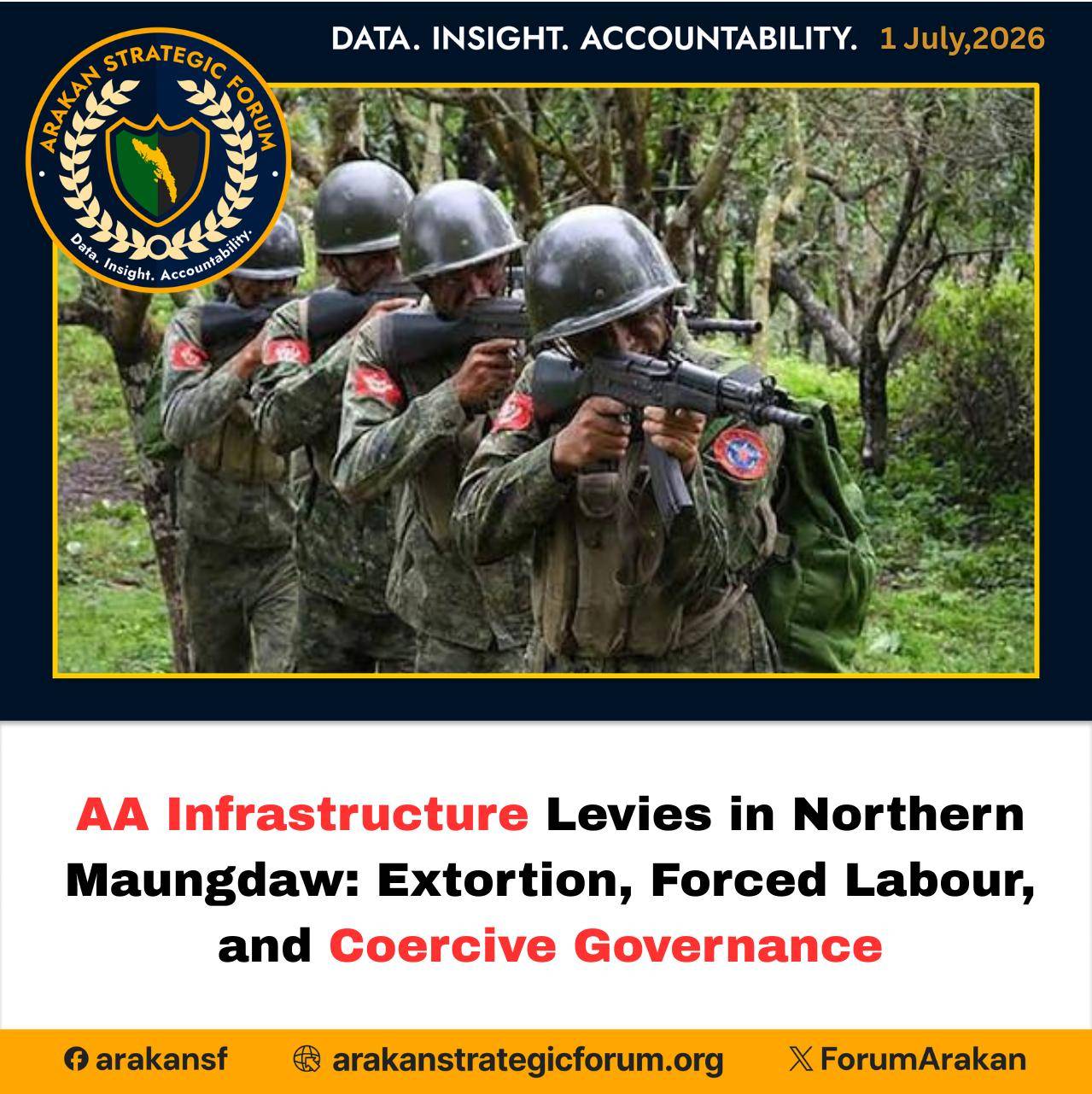
The terrorist Arakan Army/United League of Arakan (AA/ULA) is reportedly using infrastructure repair in northern Maungdaw Township as a mechanism of revenue extraction and coercive control over Rohingya Muslim communities. Under the stated objective of repairing the Kanyin Taw Bridge and the Maungdaw–Taung Pyo road corridor, the AA has imposed another round of compulsory financial collections on Rohingya businessmen and villages across former AA administrative Areas 5, 6, and Nakhka 10.
Local reports indicate that villages and Rohingya Muslim business figures have been ordered to contribute between 4 million and 10 million kyats each. This latest collection reportedly brings the cumulative amount raised for the same road and bridge repair project to nearly 300 million kyats. It is also described by residents as the fourth major levy imposed for identical infrastructure works, raising serious questions about accountability, project delivery, and the use of collected funds.
Despite repeated collections, the relevant infrastructure remains in poor condition. The Kanyin Taw Bridge continues to deteriorate during the rainy season, with sections reportedly becoming unusable for ordinary transport and passable only by motorcycles. For affected communities, the gap between repeated financial demands and limited visible repair work has deepened suspicion that infrastructure has become less a public-service project than a recurring revenue instrument.
The reported abuse extends beyond financial coercion. Rohingya Muslim residents are also said to be compelled to provide unpaid labour for the same projects they are forced to finance. Accounts from the area describe civilians being ordered to break stones, transport materials, and participate in road repair without wages, adequate food, or basic safety protection. Earlier reports similarly indicated that entire Rohingya villages were instructed to supply labourers for AA-controlled construction and repair works under coercive conditions.
This pattern should not be understood as ordinary taxation, emergency reconstruction, or community mobilisation. It reflects a coercive governance model in which a vulnerable civilian population is compelled to finance infrastructure, provide unpaid labour for its implementation, and accept the absence of transparency or equal civic benefit. In practical terms, infrastructure has become a tool through which the AA extracts money, mobilises labour, and reinforces administrative control over Rohingya Muslim communities.
The broader significance lies in the convergence of financial extortion, forced labour, discriminatory administration, and movement restrictions. Taken together, these practices suggest that AA-controlled areas in northern Arakan are developing a system in which Rohingya Muslims are treated primarily as a source of revenue and labour rather than as civilians entitled to protection, due process, and basic dignity.
For international observers, the issue is not merely local corruption or poor project management. It is a governance indicator. The AA’s conduct toward Rohingya Muslim communities in northern Maungdaw provides an important measure of how armed authorities exercise power when they control territory, population movement, labour, and economic life. A system that funds itself through coerced civilian contributions and unpaid labour cannot be separated from wider concerns over rights protection, civilian security, and the future political order in Arakan State.
The international community, humanitarian actors, and regional governments should treat these reports as part of a wider pattern of coercive rule. Infrastructure in conflict-affected areas must not become a cover for extortion, forced labour, or discriminatory control. Without independent monitoring, transparent accountability, and protection for affected communities, AA-administered areas risk consolidating a governance model built on extraction rather than civilian protection.