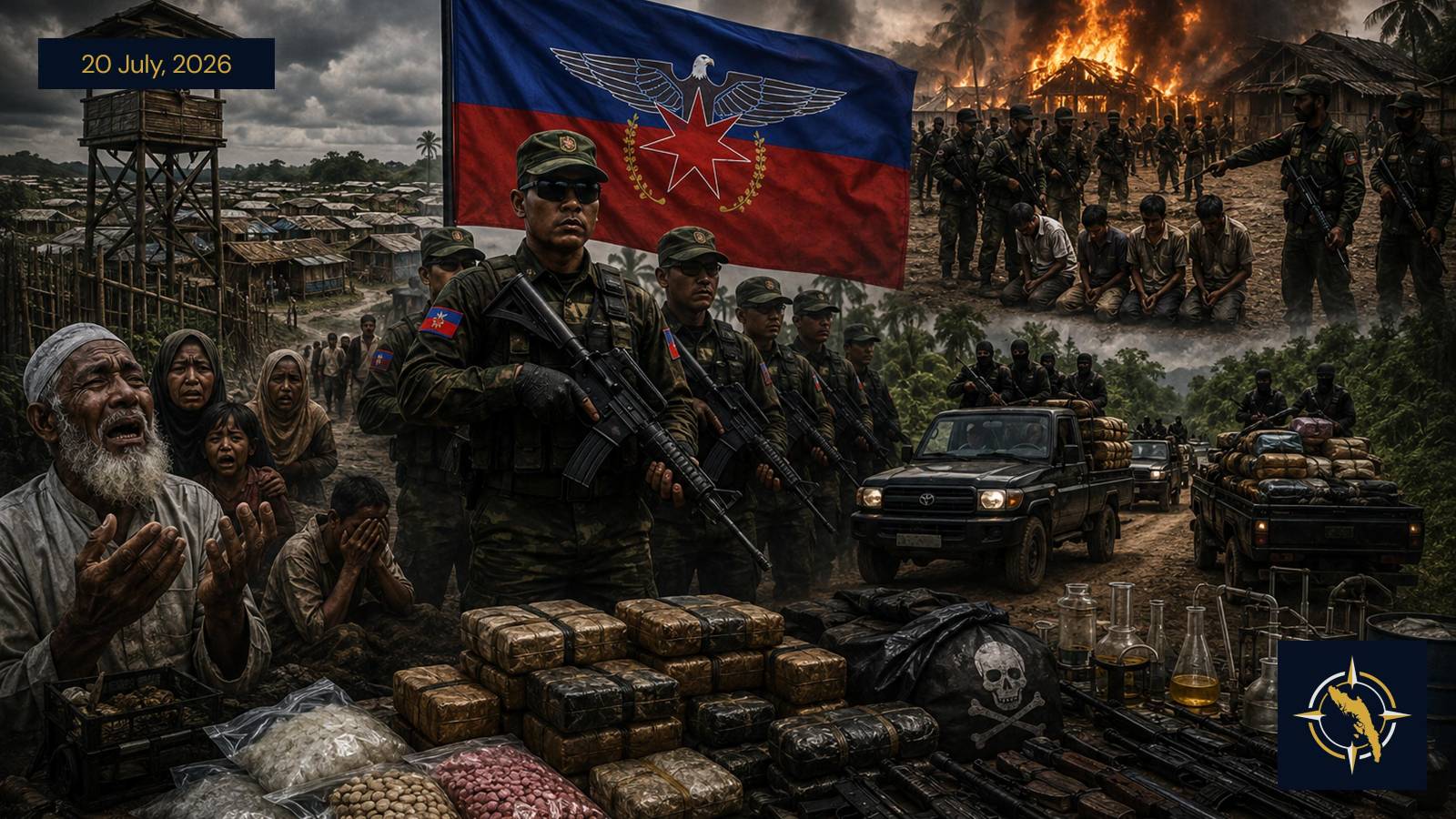
The Arakan Army is being celebrated in Western capitals as Myanmar’s most effective insurgent force. The evidence from the territory it governs tells a different story: of a genocide completed by administration, a million refugees held at the border, and Asia’s most dangerous new narco-terrorist power.
Within hours of its publication on 17 July 2026, the Jamestown Foundation’s conclusion that the Arakan Army (AA) had become “Myanmar’s most effective insurgent force” was circulating through diplomatic inboxes from Bangkok to Brussels, another welcome data point in the comforting story that Myanmar’s civil war has produced, at last, a winner the world can work with.
But the problem with the story. It is written almost entirely from the group’s own account of itself. In the townships of northern Arakan that the AA actually administers (Maungdaw, Buthidaung, the historic Rohingya inhabited areas) a different record is accumulating, in refugee testimony, border-security reporting, and the quiet bureaucratic paper trail of permits, levies and sentences. Read together, that record does not describe a pragmatic liberator. It describes something considerably darker.
Three conclusions follow.
(01) The first is that the AA is executing the administrative phase of the Rohingya genocide, completing, by permit, tax and sentence, what the Tatmadaw began by fire in 2017.
(02) The second is that the AA, not the junta, is now the decisive obstacle to the repatriation of more than 1.3 million refugees from Bangladesh.
(03) The third is that the group’s political economy has crossed the threshold from ethnic insurgency into narco-terrorist power , the most dangerous in Asia. Each claim is examined in turn below. None appears in the Jamestown assessment.
I. The Corruption of Analysis: How “Effectiveness” Became a Laundry Service
On 17 July 2026, the Jamestown Foundation published “The Arakan Army Has Become Myanmar’s Most Effective Insurgent Force.” It states a firm conclusion and arranges selected facts around it. Nowhere does it define “effective.” Nowhere does it state the standard by which the AA outranks the KIA, the UWSA, the MNDAA, the TNLA, or the Karen and Karenni forces. The piece rests on a single indicator ( territorial control ) severed from the nationwide war and from the lived experience of the people under that control.
Precision matters here, because insurgency studies has carried a working definition of effectiveness for half a century: the capacity to hold ground, degrade the enemy, replace losses, sustain logistics, maintain genuine community support, and convert military gains into durable political achievement. Measured against that standard, the article is not an assessment. It is a repackaging.
Consider its evidentiary base: the Global Arakan Network run by AA chief own brother, Development Media Group, Narinjara, the Centre for Arakan Studies, and official AA statements, platforms run by group’s own information structure.
The article itself labels the Global Arakan Network a “propaganda media front,” then cites it as evidence in the following paragraph. A first-year graduate student would be failed for this.
Meanwhile, the excluded record is long: Rohingya victims’ testimony, Bangladesh border-security reporting, the detention of more than one hundred Daingnet community members in Maungdaw, corruption allegations against AA administrators in Kyauktaw and Maungdaw, and documented extortion and forced labour across AA-controlled areas.
This failure has a name and a history. Since 2021, Western commentary on Myanmar has needed a hero. The romance of armed resistance became so powerful that an entire ecosystem of analysis developed a blind spot the size of Arakan: an armed group fighting the Tatmadaw is presumed virtuous; a group that builds courts and reopens a mosque for the cameras is presumed legitimate.
The Rohingya, who inconveniently persist in describing what is actually happening to them are treated as noise in the signal.
There is an old rule of tradecraft: when a source tells you only what it wants you to believe, you are not being informed — you are being run.
II. The Second Phase: Genocide by Administration
The world’s mental image of the Rohingya genocide is fixed in August–September 2017: burning villages, massacres, the exodus of some 750,000 people. What too few understand is that genocide, as a process, did not end in 2017. It changed management.
The AA inherited the post-2017 demography of northern Arakan: a reduced, encircled and terrorized Rohingya remnant, concentrated in Maungdaw and Buthidaung. Since 2024, the burning and emptying of Buthidaung town in May of that year; the August 2024 killings of Rohingya civilians massed on the Naf riverbank at Maungdaw, in which scores, by some witness accounts hundreds, died in drone and artillery strikes attributed to the AA by survivors and rights investigators; the forced recruitment drives that emptied Rohingya villages of their young men — the pattern has been consistent. The AA denies each incident in turn. The pattern is the denial’s refutation.
What has followed in 2025–2026 is what political psychology recognizes as the shift from cataclysmic violence to humiliation architecture: coercion engineered to make a population’s continued existence in place intolerable, so that its departure appears voluntary.
The reported record from Maungdaw Township reads, in that light, as a coherent system rather than a set of isolated abuses:
- Forced recruitment — Rohingya men aged 18–30 are again being conscripted, consuming the community’s labour, seeding it with the stigma of collaboration, and guaranteeing that any future violence can be blamed on “combatants.”
- Movement as ransom — paid travel permits valid for only two days; fees for permission to travel for medical treatment. A sick person’s geography becomes a revenue line.
- Religious strangulation — mosque loudspeakers restricted in Bu Pye Township while Buddhist monasteries face no such restriction; a mosque in Buthidaung converted into a military field office and recruitment centre; taxes levied on animals purchased for Eid al-Adha sacrifice.
- Legal apartheid — Rohingya returning from Bangladesh sentenced to three years for illegal crossing — six times the six-month maximum under the AA’s own published law. One community, one punishment; another community, another.
- Economic exsanguination — villages reportedly forced to raise roughly 3,000 lakh kyat (some US$1.4 million) for bridge repairs under threat of land seizure; a monthly “night security” levy of 60,000 kyat per family — the community paying its own jailers; fishing equipment confiscated from Rohingya fishermen and resold to Rakhine fishermen; markets built on confiscated Rohingya farmland, with advance payments extracted from traders before shops were allocated.
- Identity terror — forced identity and population checks from March through June 2026: the bureaucratic re-enactment of the 1982 citizenship logic, now enforced by Rakhine nationalism rather than Burmese.
It is the deliberate manufacture of a permanently hostile — and then permanently absent — population. The strategic aim, visible in the sum of these measures, is the removal of the remaining Rohingya from Arakan: the completion, by administrative means, of what the Tatmadaw began by military ones.
The argument should be stated in legal terms, because the legal terms fit: a course of conduct inflicting conditions of life calculated to bring about a group’s physical destruction, in whole or in part, joined to demonstrable discriminatory intent, meets the conduct element of genocide. The international community’s failure is not that it cannot see this. It is that it has decided, for now, to call it “pragmatic governance.”
III. The Repatriation Veto
Strip away every other actor in the repatriation file and ask a brutal question: who physically decides whether the Rohingya go home? Not Naypyidaw, which hosts the camps. Not the United Nations, which convenes the conferences. The Arakan Army. It holds Maungdaw, Buthidaung.
Repatriation without its effort is a fiction; repatriation with its consent, on the evidence above, is a death sentence.
This is the sleight of hand at the centre of the “pragmatic actor” narrative. The AA seeks recognition, humanitarian access arrangements and de facto border legitimacy , while the people whose return would undo its demographic project remain in Cox’s Bazar, and while those inside its territory are squeezed by the measures catalogued above. A group that blocks the return of 1.3 million refugees while courting recognition is not being pragmatic.
It is running the oldest play in the ethnic-cleansing handbook: change the facts on the ground, then negotiate from the new reality.
Meanwhile, experiences this not as diplomacy but as coercion: abducted fishermen , seven taken near Shah Porir Dwip on 15 June alone, in a repeating pattern; Bangladeshi citizens killed and maimed by border landmines; narcotics and weapons flowing across the Naf.
This is not a border relationship. It is pressure, applied to a neighbour already carrying the world’s largest refugee burden.
IV. The Narco-Terrorist Economy
Follow the money, the discipline the Jamestown piece conspicuously avoids. Insurgencies are not powered by legitimacy; they are powered by revenue. The AA’s revenue architecture, as reported through 2025–2026, is that of a conflict-crime conglomerate:
- Narcotics transit — five million methamphetamine tablets seized at Aunglan, Magway, reportedly bound for Arakan; documented AA involvement in moving yaba, cannabis and weapons through the Teknaf–Maungdaw Naf River corridor — the same corridor, it should be noted, across which refugees must return.
- Smuggling monopolies — seaborne cement and fertilizer smuggling as structural revenue: 3,500 bags of cement intercepted in June 2026 alone, at five to six times normal market profit. This is not opportunism; it is a supply chain.
- Maritime coercion — the systematic taking of Bangladeshi fishermen as leverage and message.
- Predatory extraction — taxation of Starlink terminals, land confiscation, border-trade levies, business extortion — the fiscal superstructure of a war economy.
V. The Military Myth
The “most effective” claim deserves the remaining nails in its coffin.
The manpower inflation. The roughly 40,000 figure originates in the AA’s own statements and friendly media. Every wartime force inflates; the figure appears to fold in allied forces in Chin State, PDF attachments in Ayeyarwady and Magway, administrative and police branches, support units, medical teams and local militias — none of them frontline infantry. A realistic Arakan-based combat strength is nearer very low.
Tellingly, in June 2026, pressure on the Paletwa axis from slightly more than 2,000 junta troops forced the AA to reposition reserves for the first time since Operation 1027. A 40,000-man army does not reshuffle for that.
The borrowed arsenal. Until recently, much of the group’s training, weapons and heavy equipment came from the KIA, UWSA, MNDAA and TNLA — a dependence even sympathetic coverage acknowledges. Effectiveness that is rented is not organic capability.
The opponent’s collapse, not the victor’s genius. From 2019 to 2022, Arakan was garrisoned by the Border Guard Police and local police — paramilitaries — while Naypyidaw prioritized central Myanmar, Kachin and Karen. After 2021, resistance across Sagaing, Magway, Chin, Karenni and Karen split junta strength; after Operation 1027 began in October 2023, the MNDAA and TNLA pinned the northern commands. The AA’s greatest victories were taken against an enemy tied down elsewhere.
The battlefield has turned. Estimated offensive activity fell from 60–65 percent in April 2026 to 45–50 percent in June, while defensive operations rose to 50–55 percent. The AA has no air force; the junta flies fighters, Y-12s, drones and gyrocopters, and fires naval artillery, against targets that cannot move — courts, police stations, tax offices, warehouses, roads. The AA took five of six positions around the Taung Maw Oo naval base but not the base, resupplied by sea. It lost a camp at Sanae. Its drones were shot down at Kyaukphyu. Sittwe stands intact, strongly defended, sea-supplied — and without Sittwe, there is no full control of Arakan. Neither declared 2026–2027 objective, Sittwe or Kyaukphyu, has been achieved.
The adversary is adapting. From 6–17 July 2026, Russian and Myanmar special forces ran Exercise “Tropical Storm” in Naypyidaw — the first joint land exercise since 2021 — covering FPV drones, counter-drone systems, electronic warfare and jungle assault, with Russia transferring Ukraine-derived counter-drone experience. The AA’s great equalizer is the cheap FPV drone. If that edge is electronically neutralized, the Kyaukphyu shoot-downs are the overture, not the anomaly. Meanwhile Naypyidaw’s post-April 2026 USDP-centred political reformatting, and the junta leader’s state-level receptions in Beijing in June — eighteen cooperation agreements signed — and in India in May and June, are not the profile of an isolated regime. An analysis anchored in 2024 is not analysis; it is nostalgia.
VI. Leverage or Exposure: The Geopolitical Ledger
The claim that holding Chinese and Indian infrastructure confers strategic independence inverts the risk. The AA claims authority over ten of eleven BRI projects in Arakan — which means nearly every major Chinese investment there is hostage to a war zone. The stalled Kyaukphyu deep-sea port and railway read as readily as blockage as leverage. Beijing talks to all sides, but recognition, investment relations and signatures remain with Naypyidaw.
The Kaladan corridor — Sittwe–Paletwa–Mizoram, India’s gateway to the Bay of Bengal — runs straight through AA-held territory, which is precisely why Delhi now discusses border security, intelligence sharing and rupee–kyat settlement with the junta. What is celebrated as leverage is pushing both neighbours back toward the regime the AA exists to fight.
VII. The Psychology of the Victor-Perpetrator
The psychology of armed movements supplies the dynamic at the core of this assessment. Rakhine nationalism carries a genuine, historical grievance — colonization, Burmanization, neglect. The AA converted that grievance into power with real skill. But there is a well-documented sequence in which the traumatized in-group, upon seizing power, does not transcend the logic of its victimization — it administers that logic to the next group down the hierarchy. The victim becomes the meticulous perpetrator.
The telltale signature is not the massacre. It is pettiness systematized: the two-day permit, the mosque loudspeaker ban, the tax on the sacrificial animal, the 60,000-kyat fee for “night security,” the triple-maximum sentence for one ethnicity alone. Grand terror declares intent and invites intervention. Micro-coercion achieves the same demographic outcome beneath the threshold of international attention, while furnishing the perpetrator with plausible deniability and the narcissistic satisfactions of total control.
The AA is repeating, with chilling fidelity, the junta’s own historic error: it is manufacturing a permanently hostile population inside the state it claims to be building. And it has absorbed the junta’s second lesson too well — that if you control the narrative channels, the think-tanks of distant capitals will do your laundering for you.
Final Word
In 2017, the world said “never again,” and meant it for one perpetrator. The measure of that promise is whether the principle survives the perpetrator’s change of uniform. The Arakan Army’s achievements are largely the negative outcome of state failure, not organizational genius; its governance, for one community, is a slow-motion removal; its economy is a conflict-crime conglomerate; and its narrative is currently winning — not because it is true, but because too many institutions have found it convenient.
Arakan’s history yields a final lesson: the first casualty is never the truth. The truth survives. It is the Rohingya who keep dying for it.