
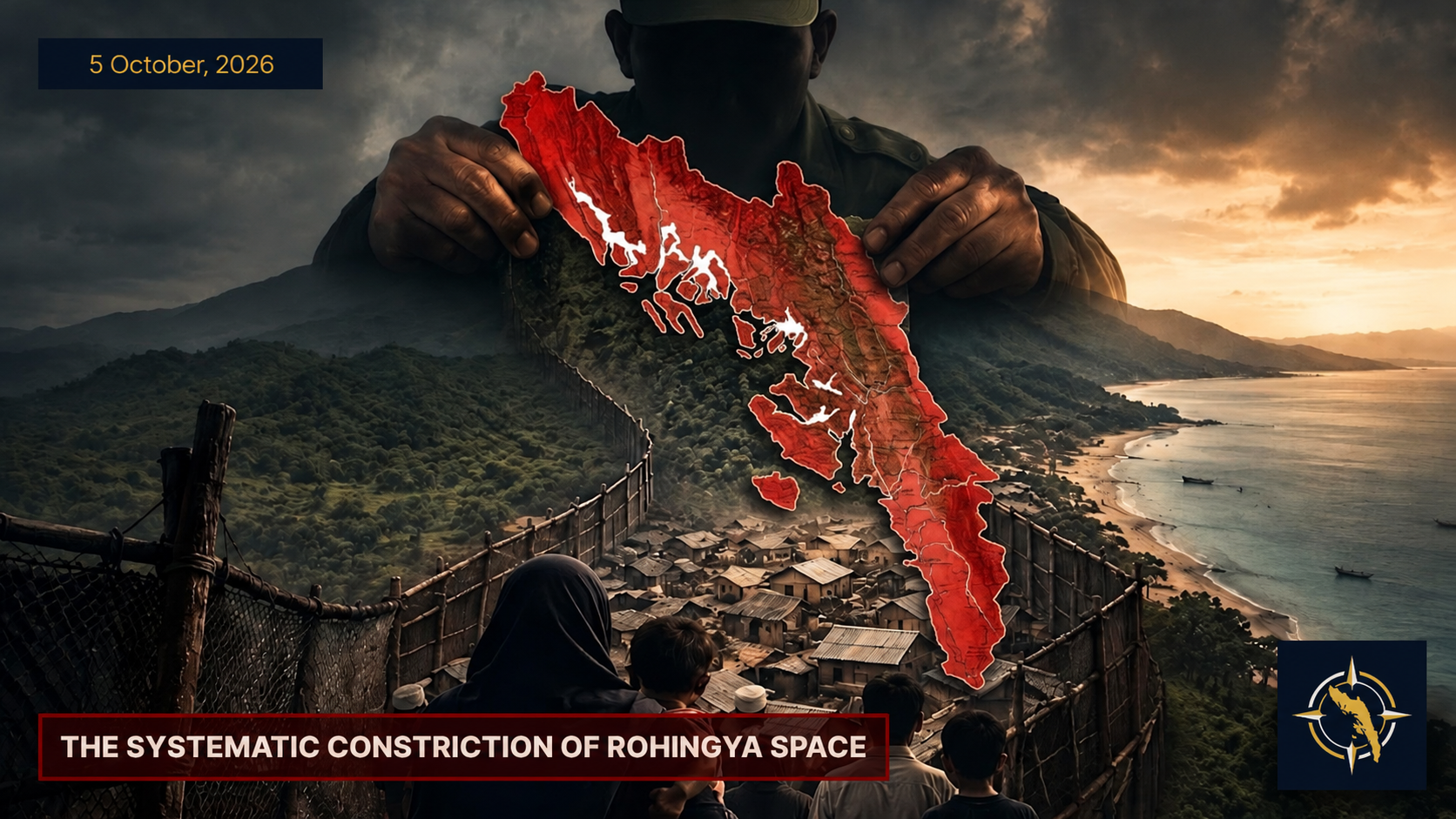
The transfer of large areas of northern Arakan from Myanmar military control to the Arakan Army has produced more insecurity for the Rohingya population.
Instead, evidence documented between 2024 and October 2026 indicates an expanding pattern of land confiscation, destruction and repurposing of Rohingya settlements, forced labour, compulsory recruitment, arbitrary detention, movement restrictions and coercive control over civilian life.
The strategic significance lies in the cumulative effect.
Rohingya communities are not merely confronting individual abuses. Their ability to remain on their land, sustain livelihoods, move between communities, preserve property and ultimately exercise a right of return is being progressively weakened.
Recent evidence raises an increasingly serious question: whether AA control in northern Arakan is producing conditions in which Rohingya displacement becomes not temporary, but structurally irreversible.
From Territorial Expansion to Civilian Dispossession
The narco-terror Arakan Army has progressively displaced Myanmar military forces from large areas of Arakan since renewed fighting began in November 2023.
By 2024, this included much of northern Arakan—territory containing the Rohingya population centres of Buthidaung and Maungdaw.
What followed is increasingly important.
A major Guardian investigation published on 1 October 2026, using satellite imagery, internal UN material, survivor testimony and verified visual evidence, found extensive destruction and alteration of Rohingya settlements after AA forces established control.
The investigation reported that at least 800 hectares of land across 23 Rohingya villages had been confiscated or repurposed since 2024. Land formerly occupied or cultivated by Rohingya was reportedly converted into military infrastructure, displacement sites or settlements intended for other communities.
The issue is therefore no longer confined to people being forced from particular locations.
The land itself is changing hands.
Homes disappear. Agricultural access is lost. Settlement structures are removed. Building materials are reused. New facilities emerge where Rohingya communities previously existed.
Each physical alteration creates another obstacle to eventual return.
Erasing the Physical Basis of Return
This distinction is critical.
Displacement becomes substantially harder to reverse when the physical and economic foundations of a community are dismantled after its population has fled.
The destruction or reassignment of residential land affects more than shelter. Agricultural land determines food security and income. Markets support local commerce. Mosques, schools and community facilities sustain social continuity. Roads and river access connect villages to neighbouring economic centres.
When these assets disappear together, the displaced population loses not only residence but the infrastructure required to resume civilian life.
The June 2026 findings of the Burma Human Rights Network illustrate the severity of this process.
BHRN reported that more than 300 Rohingya from at least six villages in northern Maungdaw were compelled to construct infrastructure for ethnic Arakan settlements at Sapay Kone and Maung Hna Ma—locations described as former Rohingya villages where Rohingya-owned land had been confiscated.
The reported sequence is particularly consequential:
Rohingya land is confiscated → Rohingya inhabitants lose control of the property → new settlements are established → Rohingya civilians are compelled to provide the labour required to construct them.
If sustained, such a process does not merely manage wartime displacement.
It changes demographic realities on the ground.
Forced Labour as a System of Coercion
Forced labour has become one of the most consistently documented features of AA conduct toward minorities in areas under its control.
Fortify Rights interviewed 21 survivors and witnesses between November 2024 and October 2025 and documented Rohingya, Hindu, Chakma and other civilians being compelled to carry ammunition and supplies, construct military fortifications, repair trenches and military compounds, maintain roads, clear vegetation and perform other unpaid work.
In several documented locations, at least one person from each household was reportedly required to provide labour.
Refusal carried consequences.
Survivors described threats, physical violence, detention, restrictions on livelihood and movement, and substantial financial penalties. Some civilians were detained after refusing compulsory labour and subsequently forced to work while in custody.
These accounts suggest something more organised than isolated misconduct by individual personnel.
Labour demands were reportedly channelled through village authorities, quotas were imposed on households, penalties were applied for non-compliance, and civilian manpower was redirected toward military and infrastructure requirements.
The resulting mechanism combines administrative pressure with armed coercion.
For already impoverished Rohingya families, the effects extend beyond the period of forced work itself. Time spent performing uncompensated labour means time removed from farming, fishing, trade and other activities necessary for survival.
Coercion therefore carries an economic function as well as a military one.
Forced Recruitment and Arbitrary Detention
Compulsory labour has increasingly overlapped with forced recruitment.
Fortify Rights documented Rohingya and other minority civilians being compelled to undergo military training, porter ammunition and supplies, dig defensive positions and perform labour near active conflict areas.
Its separate investigation into abuses committed during 2024 and 2025 documented killings, abductions, torture and arbitrary detention involving Rohingya civilians, including individuals accused without adequate evidence of association with Rohingya armed organisations.
These practices produce another form of vulnerability.
Rohingya civilians can become exposed simultaneously to suspicion from armed actors, recruitment pressure and punishment for refusing cooperation.
The distinction between civilian protection and military manpower consequently becomes dangerously blurred.
Independent human-rights organisations have continued to report arbitrary detention, forced labour, torture, killings, movement restrictions and forced recruitment affecting Rohingya under AA control.
Movement as a Controlled Privilege
Control over land is reinforced by control over movement.
Reports from AA-controlled areas describe Rohingya being required to obtain recommendation letters or authorisations to leave villages, cross checkpoints or travel to urban areas.
Local reporting from Kyauktaw in 2026 describes multi-stage permission requirements involving village-level authorities, township structures and local security offices, accompanied by payments.
Specific fee structures reported locally remain difficult to independently verify because access to the area is highly restricted. The broader pattern of movement restriction, however, is consistent with documentation from international human-rights organisations.
The practical consequences are extensive.
A farmer unable to reach agricultural land loses production.
A trader unable to reach a market loses income.
A patient unable to travel freely faces delayed medical treatment.
Families become separated between villages.
Economic activity becomes conditional on permission.
A population already deprived of recognised citizenship rights therefore becomes dependent upon the discretion of an armed authority for ordinary movement.
This is not simply checkpoint security.
It is control over the basic geography of civilian life.
The Architecture of Constriction
Viewed individually, land seizure, forced labour, travel restrictions and detention may appear to constitute separate categories of abuse.
Viewed together, they form a mutually reinforcing system.
Land control determines where Rohingya can live.
Movement control determines where they can travel.
Labour coercion determines how their physical effort can be used.
Detention and recruitment pressure increase the cost of refusal.
Property redistribution weakens the possibility of return after displacement.
The result is a progressive narrowing of civilian space.
This is the central strategic development.
The Rohingya presence in northern Arakan can diminish even without a single formal order demanding mass expulsion. Communities can instead be rendered increasingly unsustainable through cumulative restrictions on property, livelihood, mobility and personal security.
Flight then becomes the consequence of conditions rather than necessarily the product of a single expulsion directive.
Displacement Is Becoming Self-Reinforcing
The effect is already visible across the Bangladesh border.
More than 150,000 additional Rohingya have reportedly entered Bangladesh since renewed conflict and persecution intensified after 2024, adding to an existing refugee population of approximately 1.2 million.
Many fled a conflict in which Myanmar military airstrikes and other attacks remain a major civilian threat. But testimony gathered by journalists and human-rights organisations also identifies AA abuses, land loss, forced labour, detention and insecurity among the pressures driving continued displacement.
Every additional departure creates another vulnerability.
Abandoned land becomes easier to appropriate.
Documentation is lost.
Property claims become harder to enforce.
Homes deteriorate or are removed.
New populations or facilities may occupy former settlements.
The longer this process continues, the greater the difference between the theoretical right of return and the practical ability to exercise it.
A Direct Threat to Future Repatriation
This has profound implications for Bangladesh and for international efforts concerning Rohingya repatriation.
Diplomatic discussions frequently treat repatriation as a question of whether Myanmar will accept refugees back.
That is no longer sufficient.
A credible return requires answers to at least five fundamental questions:
Can Rohingya recover their original land?
Can they move freely after returning?
Will they possess recognised legal documentation?
Can they obtain livelihoods without coercive restrictions?
Will an independent mechanism exist to challenge confiscation, detention or abuse?
Without these conditions, transportation across the border cannot constitute sustainable repatriation.
A refugee returned to an area where his village no longer exists, his land has been reassigned, his movement requires permission and his family remains vulnerable to forced labour has crossed a border—but has not recovered a viable civilian life.
This distinction should become central to international policy.
Demographic Change and the Question of Permanence
The most serious long-term concern is the interaction between displacement and settlement change.
BHRN’s June 2026 documentation of Rohingya labour being used to build settlements for ethnic Arakan families on confiscated Rohingya land requires particular scrutiny.
The Guardian investigation similarly identified widespread alteration and repurposing of former Rohingya areas.
Legal experts cited in connection with these developments have raised questions concerning forced population transfer and other possible violations of international humanitarian law.
Final criminal responsibility requires investigation of individual acts, command responsibility, knowledge, intent and applicable legal standards.
But strategic analysis does not require waiting for a future judicial judgment to recognise the underlying danger.
Once displaced populations lose land while new settlement patterns become entrenched, reversing displacement becomes substantially more difficult.
Temporary wartime change can become permanent demographic reality.
AA Statements and Conditions on the Ground
The ULA/AA has repeatedly presented itself publicly as representing the interests of the different communities of Arakan.
Such statements must be assessed against measurable conduct.
The relevant indicators are not declarations but conditions experienced by civilians:
whether confiscated Rohingya land is restored;
whether forced labour ends;
whether Rohingya can travel without discriminatory permission systems;
whether arbitrary detention is subject to meaningful review;
whether displaced families can return to their original villages;
whether Rohingya property can be inherited and transferred;
whether humanitarian organisations receive independent access;
and whether abuses by AA personnel are investigated through credible and transparent mechanisms.
Until such protections become observable, public assurances cannot substitute for evidence on the ground.
The Wider Conflict Does Not Reduce AA Responsibility
Myanmar’s military remains responsible for grave abuses across Arakan, including airstrikes affecting civilian areas, historic persecution of the Rohingya and continuing restrictions on humanitarian access.
Rohingya armed organisations have also faced allegations of abuses, including abduction and forced recruitment.
These realities do not diminish responsibility for abuses committed by the AA.
Multiple perpetrators can operate simultaneously within the same conflict.
The Rohingya have repeatedly been placed between armed actors while possessing little effective political, legal or military protection of their own.
The appropriate analytical framework is therefore not to determine which actor’s violations excuse another’s.
It is to establish who controls a population, what powers that actor exercises, and what documented consequences follow from that control.
In much of northern Arakan, AA territorial control now makes its conduct unavoidable to any serious assessment of the Rohingya’s future.
Conclusion
Northern Arakan is undergoing more than a military transition.
Its human geography is being altered.
Available evidence shows Rohingya land being confiscated and repurposed, civilians being compelled to provide labour, movement being restricted, individuals being detained or recruited under coercive conditions, and displaced communities facing increasing obstacles to recovering their former homes and livelihoods.
The danger is cumulative.
A village does not have to be formally abolished to disappear. Its residents can be displaced, its land reassigned, its buildings removed, its economy severed and its return progressively made impossible.
That is why the most consequential question confronting northern Arakan is no longer simply who controls the territory.
It is whether Rohingya communities will retain a viable territorial, economic and political existence within it.
For Bangladesh and the international community, the implication is equally clear: Rohingya repatriation cannot be separated from what is happening to Rohingya land today.
If homes disappear, property ownership is extinguished and demographic changes become entrenched while refugees remain across the border, future negotiations may confront a fait accompli—a population possessing a recognised right to return, but progressively losing the physical homeland to which that right can meaningfully be exercised.
Preventing that outcome requires scrutiny of current developments now, not after the territorial transformation of northern Arakan has become irreversible.