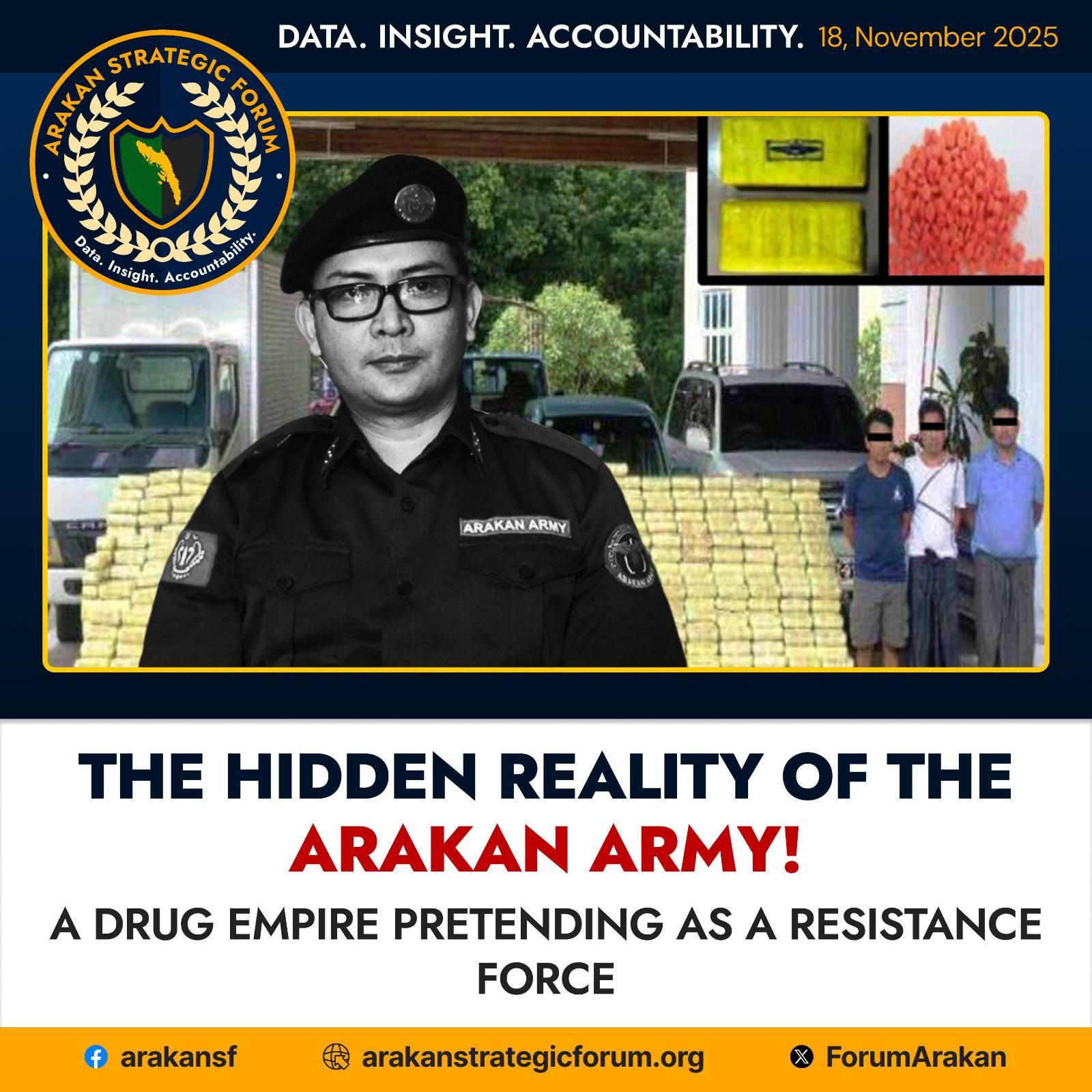
When the Arakan Army (AA) swept through parts of Arakan State (Rakhine State) in late 2023, much of the world’s media hailed it as a rising ethnic resistance movement. The headlines spoke of “strategic victories” and “Arakan State (Rakhine State) self-determination.” But beneath that narrative lies a darker truth, the Arakan Army is not a liberation force. It is a drug-funded militia, built on fear, opportunism, and criminal enterprise.
A Partner in Atrocity, Not a Voice for the People
The Arakan Army presents itself as a defender of the Arakan State (Rakhine State) people, yet history tells a different story. During the Rohingya genocide of 2012,2016,2017, the AA was not standing against the junta , it was standing beside it. Witnesses and investigators have long pointed to the AA’s active cooperation with the Myanmar military during those massacres.
From 2017 onward, the group consolidated its influence by terrorizing and extorting civilians, especially Rohingya families. Human rights monitors estimate that between 900,000 and 1000,000 people were forced from their homes between 2017 and 2023, not by the army alone, but by the AA’s own campaigns of intimidation and smuggling rackets.
The Drug Money Behind the Guns
The AA’s true power does not come from ideology; it comes from narcotics. In 2018 alone, authorities in Arakan seized nearly seven million yaba pills in a matter of months. Bangladeshi border forces report that up to 95% of all yaba entering Bangladesh now flows through routes controlled or taxed by the Terrorist Arakan Army and its associates.
This drug economy funds weapons, recruits, and bribes. Local sources and security officials describe how AA leaders use narcotic profits to buy loyalty inside the junta’s lower ranks, paying officers to abandon posts or hand over arms. What many call “victories” were often simply purchased surrenders, towns taken without battle because their defenders were already bought.
Mercenaries and Meth: The True Face of the Fighters
Those who have lived under AA control tell stories of fear, not freedom. Fighters, often addicted to methamphetamine, are described as violent and erratic, looting homes, abducting young men, and assaulting women. “They don’t know who is the enemy and who is a civilian,” said one displaced villager, Nazia Begum from northern Arakan.
Much of the AA’s so-called “coalition warfare” has been mercenary collaboration, trading battlefield access and coastal routes for foreign partners’ investment and drug shipment channels into the Bay of Bengal. Its territorial control is less about strategy and more about protecting narcotics corridors that link Myanmar’s interior to ASEAN and beyond
The Power of Perception
What the Arakan Army lacks in legitimacy, it makes up for in propaganda. Through slick media campaigns and coordinated online networks, the group has created a myth of invincibility, exaggerating victories, fabricating control zones, and glorifying battlefield imagery to attract sympathy abroad.
In reality, its power is brittle. Over the past year, the AA has failed to capture three major towns where the junta put up serious resistance. Its “conquests” have mostly been abandoned settlements or lightly guarded outposts. The image of an unstoppable force masks a movement sustained by money, drugs, and fear.
The Human Cost
Ordinary civilians are paying the price. Villages caught between the junta and the AA endure bombardments, forced displacement, and endless extortion. Rohingya communities, in particular, are trapped in a double oppression, persecuted by the state and preyed upon by the very militia that claims to be fighting for justice.
Refugees report being coerced into smuggling yaba pills across the border, often under threat of violence. Others describe “taxation” systems where farmers must hand over part of their harvest or face punishment. For families already living on the edge of survival, the AA’s rule has become another form of occupation.
The Illusion of Liberation
One year after its celebrated rise, the reality is clear: the Arakan Army’s empire is built on narcotics, not nationalism. Its leaders are businessmen of conflict, dealing in meth, fear, and deception.
The world must stop romanticizing this militia. Arkan’s people,Arakan State (Rakhine State), Rohingya, and others deserve peace, justice, and accountability, not a narco-state disguised as a revolution.