
The Rohingya story is not just a record of persecution; it is a testament to human endurance under the most violent conditions imaginable. Returning from a field mission in Bangladesh, one truth becomes impossible to ignore: the world is physically far from Cox’s Bazar, but morally even farther from the suffering endured by more than a million displaced Rohingya. Standing along the Naf River the same crossing where over 700,000 fled during the 2017 genocide, the contrast is striking.
From a distance, it appears peaceful, almost serene, yet this narrow stretch of water has become a symbol of everything the Rohingya were forced to leave behind:
Burned villages, mass killings, drone attacks, and systematic persecution. Survivors like Abdul remind us that this violence is not abstract; ten members of his family were killed mid-crossing by drone-dropped explosives. His story is one of thousands. Inside the camps, the resilience is extraordinary.
Shelters funded by international donors provide dignity where the world has offered neglect. Community spaces, health clinics, registration centers, and small livelihood programs like a bakery where students perfect their final exams reveal a people determined to rebuild even when the future remains hostage to political failure. But the Rohingya’s persistence is happening in the shadows of an unresolved catastrophe.
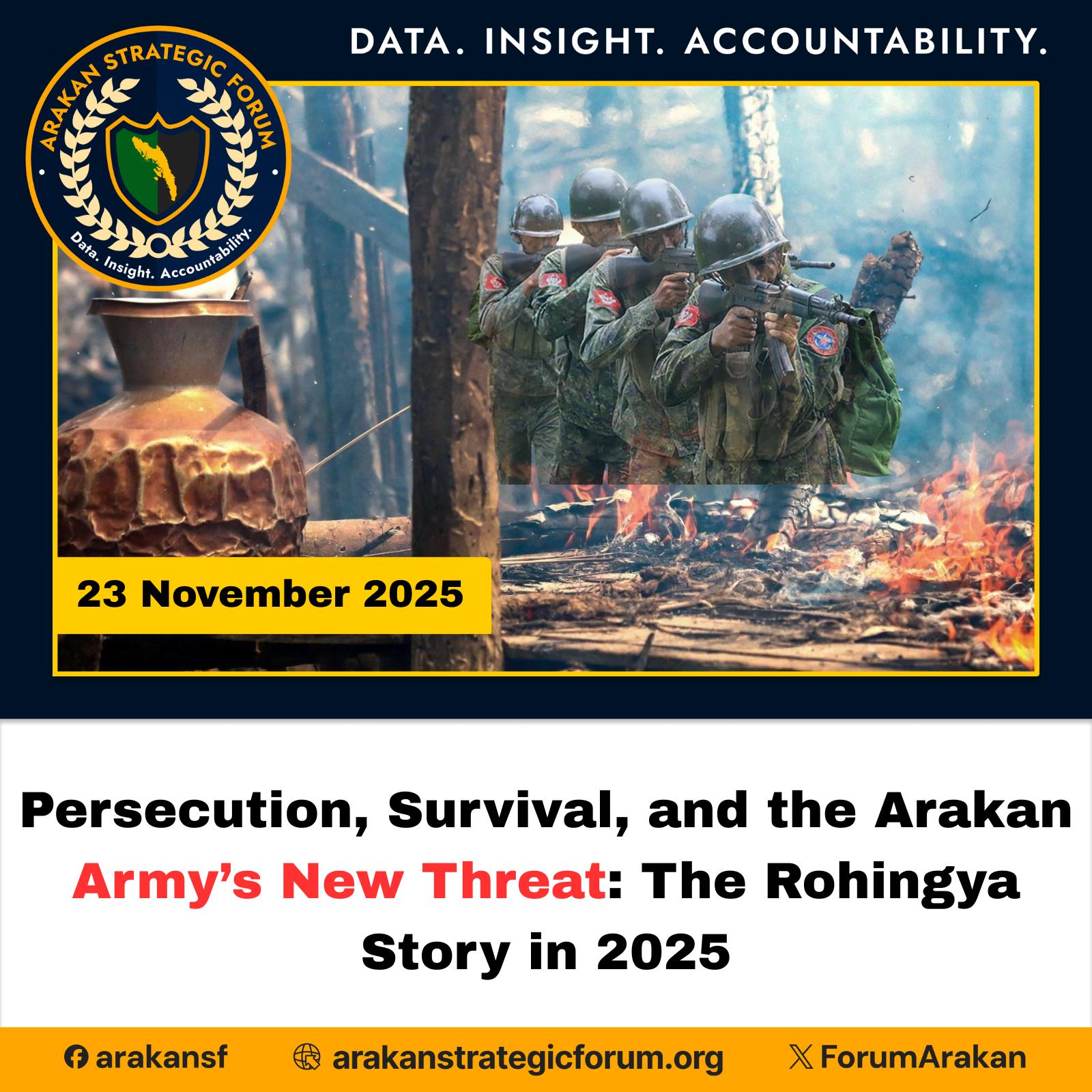
The conditions inside Arakan remain unlivable, not only due to Myanmar’s military, but increasingly due to the expanding brutality of the Arakan Army (AA). In 2024–2025, reports from northern Arakan reveal forced displacement, targeted killings, extortion, blocked movement, and deliberate intimidation of Rohingya communities by the AA, mirroring the same patterns of persecution they originally fled.
Villages have been emptied or burned, families trapped between the junta’s violence and AA’s coercion. For many, the Naf River remains a line between two dangers rather than a path to return. The world speaks of “repatriation,” but safe, dignified return is impossible when Rohingya are still being hunted, taxed, conscripted, or displaced inside Arakan. Any process that ignores AA’s role in this suffering is not a pathway home; it is a blueprint for repeat displacement.
And yet, despite everything stolen from them, citizenship, security, land, and loved ones, the Rohingya continue to show a level of resolve rarely seen in protracted crises. Their persistence is not passive; it is a quiet defiance against genocide and abandonment. What they need is not sympathy, but sustained international commitment: protection, accountability, and a political settlement that finally recognizes them as equal human beings in their own homeland. For a people who have endured every imaginable form of erasure, their hope is an act of resistance. The world must decide whether it will stand beside them or continue standing 9,200 miles away.
The 2024–2025 Violence in Northern Arakan
The 2024–2025 violence in northern Arakan has not been random battlefield displacement; it has been a targeted campaign designed to uproot Rohingya communities. Field testimonies collected from Buthidaung, Maungdaw, Kyauktaw, Rathedaung, and Pauktaw reveal: House-to-house raids on Rohingya villages searching for young men; Beatings and extrajudicial killings of those accused of refusing AA conscription; Forced taxation and ransom demands for community leaders and business owners; Seizure of Rohingya livestock, rice stockpiles, and land deeds; Roadblocks restricting movement and food access; Burning of homes belonging specifically to Rohingya families.
Satellite images from multiple monitoring organizations in late 2024 documented entire Rohingya neighborhoods in Buthidaung burned while nearby Buddhist Arakan homes remained untouched, indicating discriminatory destruction rather than collateral conflict. Survivors report that Rohingya civilians trying to flee to other villages were shot or detained, while others were forced to work as porters for AA fighters under threat of execution.
Rohingya Classification of the Arakan Army
Through these abuses and killings, many Rohingya now describe the Arakan Army as a “terrorist Arakan Army” not as a rhetorical insult, but because of deliberate, systematic violence against a civilian ethnic group. In their words:
“A force that targets civilians, burns villages, and kills children is not a liberation army it is a terrorist Arakan Army.”
No form of repatriation is meaningful if return means entering territory controlled by an armed group actively killing, displacing, and extorting the Rohingya.
The Consequences of Ignoring Arakan Army Atrocities
If the international community continues to treat the Rohingya situation as strictly a Tatmadaw problem while ignoring Arakan Army-perpetrated atrocities, three dangerous outcomes are likely in 2025: A second mass exodus from northern Arakan this time driven by AA forces; The permanent erasure of Rohingya presence in parts of Arakan State; The collapse of the concept of “safe repatriation” for a generation. The Rohingya are not between safety and danger they are between two different perpetrators of violence.