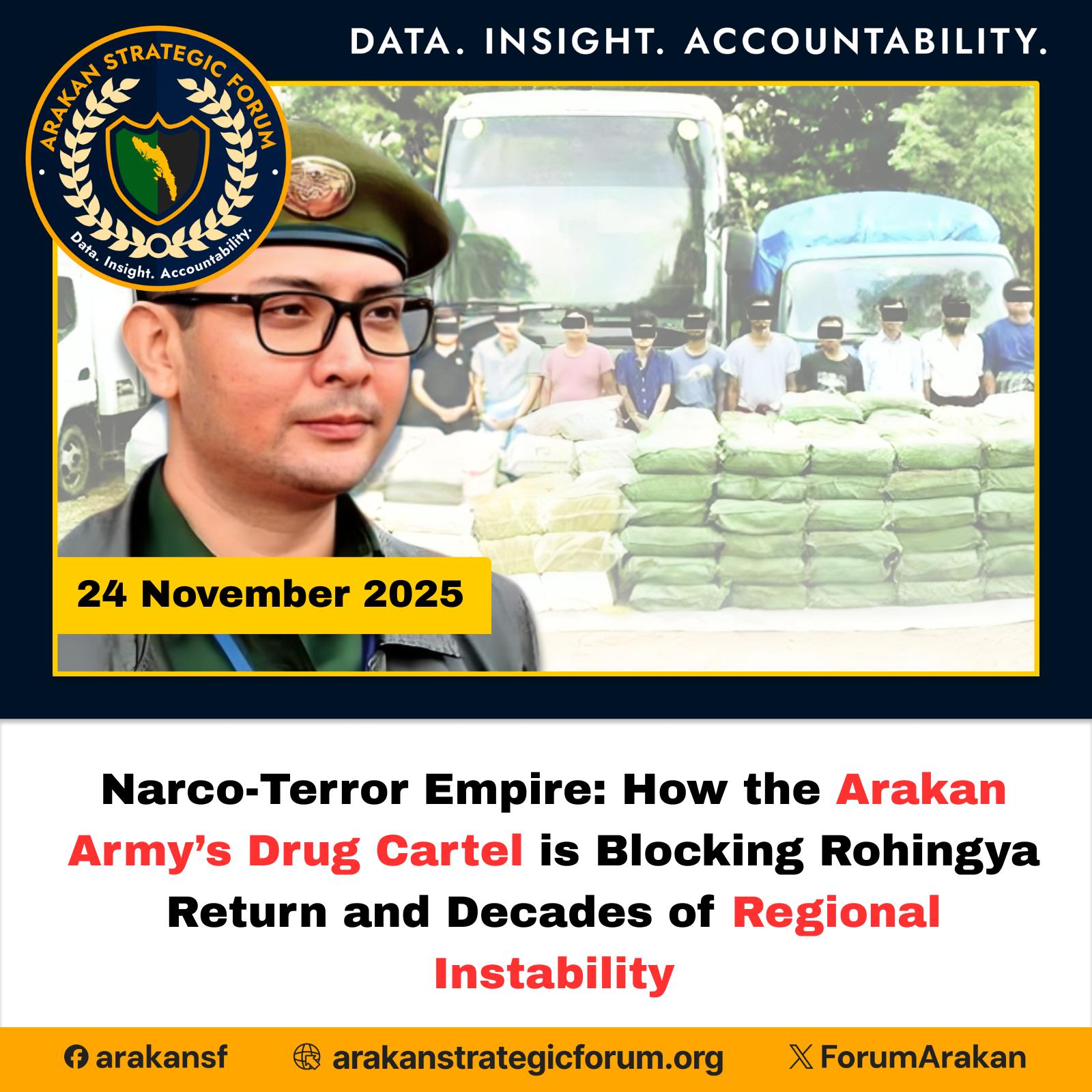
The rise of the Arakan Army’s narco-terror economy is no longer a Myanmar-only problem it is now reshaping security, stability, and the humanitarian landscape across the entire region. And at the center of this crisis, once again, stand the Rohingya, a people already destroyed by genocide and now forced into the crossfire of a militarized drug empire they never chose.
Bangladesh has long managed the fallout of conflict in Arakan, but the AA’s transformation into a fully commercialized narcotics cartel introduces a new threat. Controlling nearly 80% of Arakan, the AA no longer survives on ideology its war machine is fueled by yaba, crystal meth, and liquid drugs moving from Shan State and the Golden Triangle into Bangladesh. This is not insurgency funding; this is a regional criminal economy with national-security consequences.
Three routes now define this illicit pipeline the Naf River corridor, the Teknaf–Hnila–Hoiyang mountain line, and the St. Martin maritime zone. And in the middle of these trafficking chains, the Rohingya refugee camps have become coerced logistics hubs, not by choice but by desperation. Displaced families, trapped in limbo and denied repatriation, are being targeted, recruited, or threatened into becoming carriers. For a community already living through trauma, the AA’s exploitation adds a new layer of suffering criminalized, endangered, and blamed for a trade orchestrated by armed actors.
The numbers tell the scale: between 2020–2025, Bangladesh seized over 35.8 million yaba tablets and nearly 150kg of crystal meth, worth BDT 1,826 crore. This is only what was intercepted a fraction of what flows.
Analysts warn that this narco-terror architecture will create a decade-long crisis for Bangladesh:
• Social collapse, as youth addiction surges
• Economic drain, with billions lost to the drug shadow-economy
• Border militarization, as AA reinvests drug profits into weapons
• Regional image damage, labeling Bangladesh as a trafficking corridor
All while the Rohingya the most vulnerable population bear the heaviest burden.
Inside Arakan, the AA’s rise has brought new waves of forced displacement, taxation, intimidation, and targeted violence against Rohingya civilians. Villages have been emptied or burned; movement is restricted; families are used as forced labor or carriers. This environment makes safe, voluntary repatriation impossible. The world cannot expect the Rohingya to return to a territory where both the junta and the AA weaponize their existence.
The AA’s drug expansion is not only a threat to Bangladesh it is a direct assault on Rohingya survival, blocking their right to return, destabilizing the region, and creating a criminal ecosystem that feeds off their statelessness.
Unless regional pressure dismantles this cartel structure through surveillance, diplomacy, accountability, and camp protection Bangladesh risks a generational disaster. And the Rohingya risk being erased again, this time by a narco-state emerging in their own homeland.
The AA’s drug empire is not a border issue. It is a human rights crisis, a regional security crisis, and a Rohingya crisis all at once.