
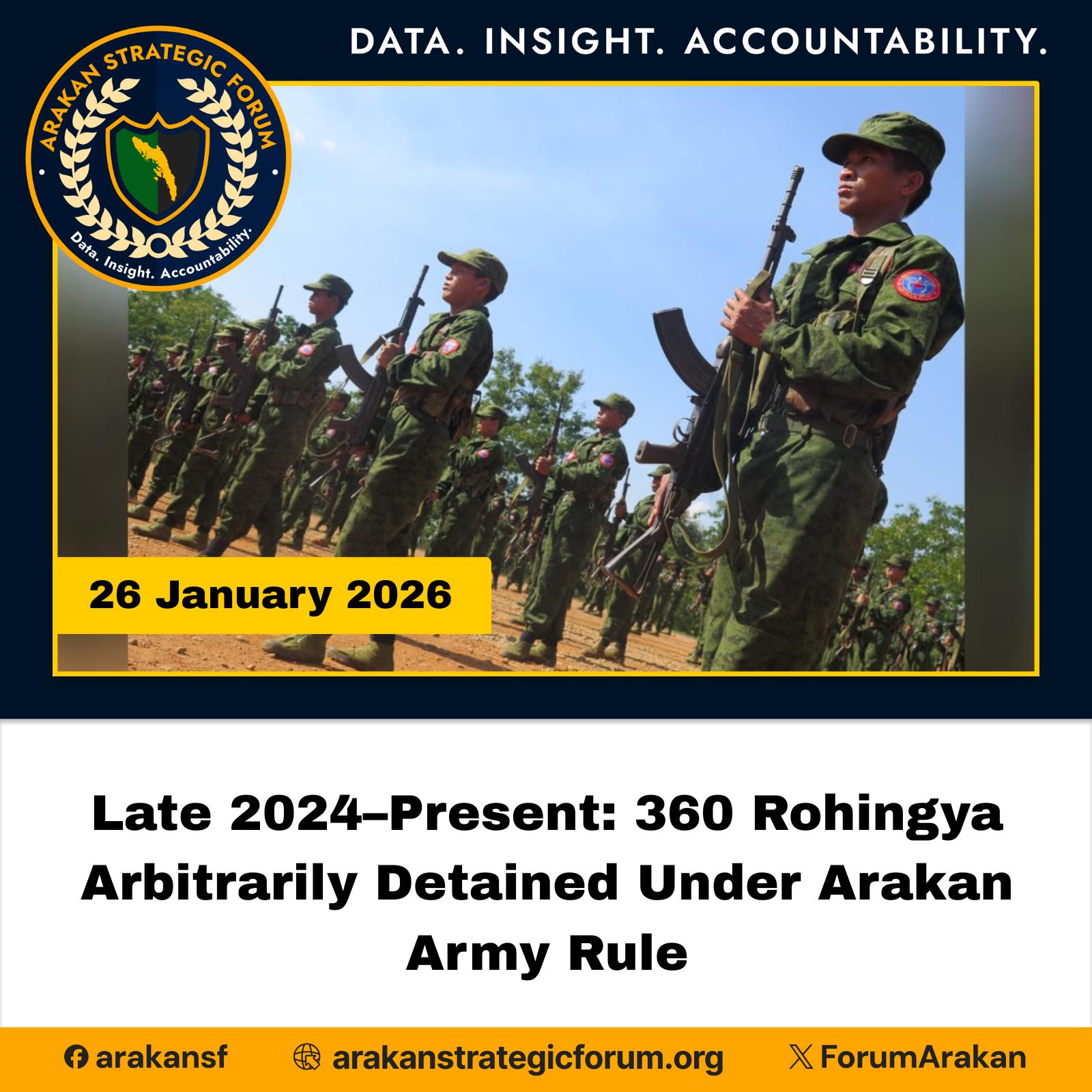
Since late 2024, more than 360 Rohingya civilians have reportedly been detained by the terrorist Arakan Army (AA) amid intensifying so-called “security restrictions” across Buthidaung Township in Myanmar’s Arakan State.
Arrests surged after AA consolidated control over rural tracts, with detentions concentrated at checkpoints, village entrances, and market routes. Those seized include farmers, traders, laborers, students, and community elders overwhelmingly civilians, with no formal charges ever presented.
Witness accounts reveal a systematic pattern: arbitrary stop-and-search operations, nighttime home raids after curfew, and mass roundups based on vague pretexts such as “non-cooperation,” “movement without permission,” or “contact with outsiders.” Detainees are routinely held incommunicado for days or weeks. Families are denied information on whereabouts, legal process, or release timelines.
In multiple cases, freedom has been conditioned on payments ranging from 50,000 to 300,000 kyats per person turning detention into a crude extortion racket.
The security regime accompanying these arrests is sweeping and punitive. Movement now requires informal permission; night travel is banned; markets operate under surveillance; and access to farmland and fishing grounds is restricted.
Analysts tracking incident patterns note that detention spikes align with resistance to forced labor quotas, refusal to pay checkpoint fees, or attempts by displaced families to return home clear evidence of coercion, not security enforcement.
Analytically, this detention surge functions as population control. By criminalizing everyday movement and imprisoning civilians en masse, the AA suppresses Rohingya mobility, dismantles livelihoods, and fractures community cohesion. The total absence of due process confirms these actions as collective punishment, not law enforcement.
These detentions deepen an already catastrophic protection vacuum marked by land seizures, food inflation, education blockades, and information blackouts.
The message is unmistakable: compliance is enforced through fear, and Rohingya existence itself is treated as a security threat. Until independent monitoring, humanitarian access, and accountability are restored, mass detention will remain a central tool of AA rule in Buthidaung at devastating and enduring human cost.