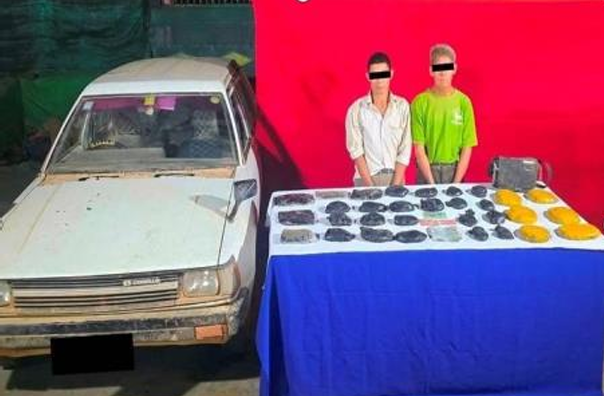
On 16 February 2026 at approximately 5:50 p.m., a joint operation by Myanmar’s Anti-Drug Police Force intercepted a Toyota Corolla near Nan Si Aung Village, Mohnyin Township (Kachin State), leading to the seizure of 8.2 kilograms of narcotics valued at approximately USD 114,800 and 4.2 kilograms of restricted psychotropic substances valued at approximately USD 50,400.
The combined regional market value exceeds USD 165,000, indicating organized distribution rather than small-scale trafficking.
The driver, Khin Maung San (alias Laung Lu), 55, and passenger Aye San, 56, were arrested on site. Authorities have identified both as active members of the terrorist Arakan Army, directly linking the armed group to narcotics transportation beyond Arakan State and into northern Myanmar corridors.
Both suspects have been formally charged under the Narcotics and Psychotropic Substances Law, with proceedings underway at Mohnyin Township Police Station.
This seizure reinforces a broader pattern: the drug mafia Arakan Army continues to embed itself in high-value narcotics flows as a financing mechanism. The quantity and valuation suggest structured logistics, supply chain coordination, and cross-regional movement.
For Rohingya communities in northern Arakan, this narco-economy has direct consequences fueling coercive governance, forced labor, land seizures, and systematic repression financed by illicit trade.
The Mohnyin case is not isolated; it reflects an insurgent-financed criminal architecture operating across state lines.
As long as narcotics revenue underwrites armed expansion, instability will persist both in border regions and in Rohingya areas where communities remain trapped under a structure sustained by drug money and coercion.