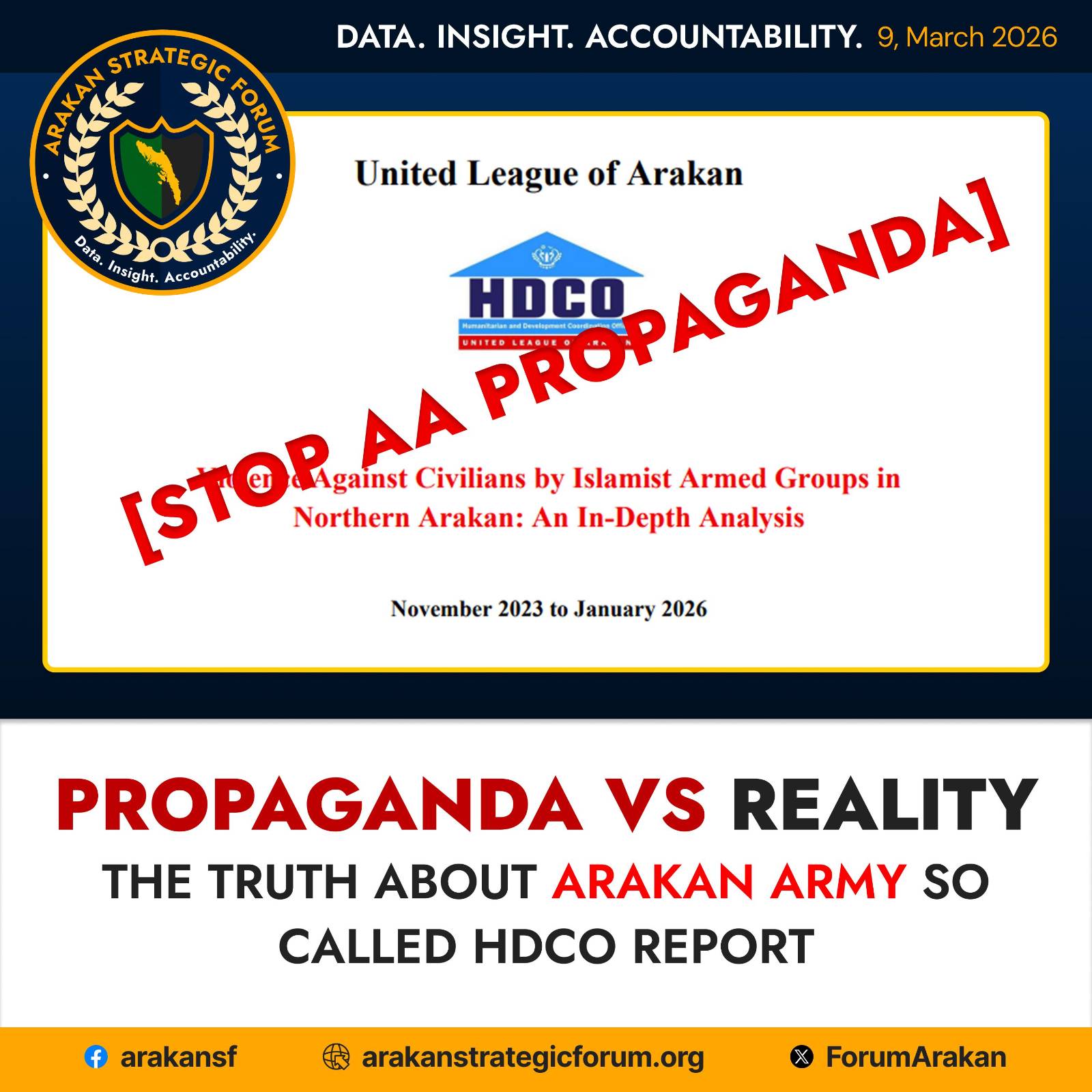
The report published by the Humanitarian and Development Coordination Office (HDCO) a subsidiary of the United League of Arakan (ULA) presents itself as a humanitarian assessment of violence in Northern Arakan. In reality, it functions as a sophisticated exercise in psychological warfare and institutional propaganda. Rather than providing an objective account of events, the document systematically redirects blame onto Rohingya communities and alleged “Islamist militants,” while obscuring credible evidence of widespread abuses committed by the Arakan Army (AA).
A careful examination of the report reveals a pattern of narrative manipulation, selective omission, and strategic misrepresentation. The purpose appears clear: to pre-empt international scrutiny and dilute mounting evidence of atrocities, displacement, and systematic targeting of Rohingya civilians in Maungdaw, Buthidaung, and surrounding areas.
A. Institutional Bias and Structural Conflict of Interest
The most fundamental flaw of the HDCO report lies in its institutional origin. HDCO is not an independent humanitarian body; it operates under the authority of the United League of Arakan, the political wing of the Arakan Army. Under basic standards of international humanitarian accountability, a combatant authority cannot credibly investigate alleged abuses occurring within territories under its own military control.
The report therefore represents a clear conflict of interest. Its conclusions function less as a neutral assessment and more as a political instrument designed to construct a “false-flag” narrative one that shifts responsibility for violence away from the AA and onto the very communities that have been subjected to displacement and mass casualties.
B. Satellite Evidence vs. Fabricated Narratives on Arson
The HDCO document attributes the burning of civilian homes and infrastructure in Northern Arakan to unspecified “Islamist militants.” However, independent investigations contradict this claim.
Satellite analysis conducted by international monitoring organizations between May 2024 and the present shows extensive structural destruction across Buthidaung and Maungdaw during periods of active Arakan Army offensives. High-resolution imagery indicates that more than 2,000 Rohingya structures were destroyed in areas that were under direct artillery range and tactical control of AA forces.
The pattern of destruction clustered burn zones following troop advances aligns with scorched-earth tactics commonly documented in conflict environments. These findings directly undermine the narrative presented in the HDCO report.
C. Civilian Displacement and the August 5 Massacre
The HDCO report portrays the Arakan Army as a force protecting civilians from militant violence. Yet testimonies from survivors, journalists, and humanitarian observers describe a dramatically different reality.
On 5 August 2024, hundreds of Rohingya civilians attempting to flee toward the Naf River were reportedly killed in a series of drone strikes. Victims included women, children, and elderly individuals attempting to cross into Bangladesh. Multiple survivor accounts and international reporting identified the Arakan Army as the operator of the drones responsible for the strikes.
The event receives minimal attention in the HDCO report despite its scale and documentation. The omission of such a critical incident raises serious questions regarding the report’s credibility and intent.
D. Weaponization of the “Terrorist” Label
A central rhetorical strategy within the HDCO document is the repeated categorization of Rohingya actors as “Islamist terrorists.” This label is applied broadly, often without distinction between armed factions, civilians, or displaced populations.
Such language serves a strategic purpose. By framing the Rohingya community primarily through a counter-terrorism lens, the report attempts to legitimize extreme security measures and military operations against predominantly civilian populations. This narrative also exploits existing global anxieties surrounding Islamist militancy, allowing political actors to portray collective punishment as a form of security enforcement.
In practice, the effect is the criminalization of an entire ethnic community struggling for survival under conditions of displacement and statelessness.
E. Siege Tactics and the Weaponization of Humanitarian Deprivation
Beyond direct military operations, the situation in Northern Arakan increasingly reflects a pattern of siege warfare. Access to food, medicine, and humanitarian assistance in Maungdaw and Buthidaung has been severely restricted.
Humanitarian networks report that aid deliveries have been blocked or delayed, leaving large civilian populations without essential supplies. These restrictions coincide with active conflict operations and have produced acute shortages across Rohingya villages.
The HDCO report simultaneously claims humanitarian concern while failing to acknowledge the impact of these blockades. The contradiction between stated intentions and conditions on the ground suggests that deprivation itself has become a tool of control.
F. Demographic Targeting and the Pattern of Male Casualties
One of the most revealing elements of the HDCO report lies within its own casualty statistics. The document acknowledges that approximately 93 percent of recorded victims were adult men.
Rather than undermining allegations of targeted violence, this statistic supports concerns raised by human rights observers. Systematic targeting of adult males within a specific ethnic community is widely recognized in international humanitarian law as a method used to dismantle social leadership structures and weaken communal resilience.
Such demographic targeting raises serious concerns regarding potential violations of the Geneva Conventions and broader prohibitions against war crimes.
G. Historical Distortion and the Question of Indigeneity
The HDCO report attempts to delegitimize the Rohingya community by portraying Muslim presence in Northern Arakan primarily as a colonial-era migration phenomenon.
This claim ignores extensive academic research documenting centuries of Muslim settlement in the region, long predating British colonial administration. By framing Rohingya communities as recent “Chittagonian immigrants,” the report echoes narratives historically used by the Myanmar military to justify exclusion from citizenship and the denial of legal rights.
The strategic use of historical revisionism serves to “other” the Rohingya population, thereby rationalizing displacement and demographic restructuring.
H. The Narrative of Minority Protection
Another recurring claim within the report is that the Arakan Army is protecting smaller indigenous minorities such as the Mro, Thet, and Daingnet from alleged Islamist threats.
However, reports from the region indicate that members of these communities have themselves faced forced recruitment, displacement, and coercion within AA-controlled areas. Rather than representing a protective framework, the narrative of minority defense appears to function as a political instrument designed to cultivate inter-communal mistrust between Buddhist and Muslim populations.
By positioning certain groups as protected allies and others as existential threats, the report reinforces a divide-and-rule dynamic that strengthens the AA’s political control.
I. Allegations of Rohingya–Junta Coordination
The HDCO document further claims that Rohingya armed groups are coordinating with the Myanmar military junta. Such assertions carry severe consequences in the context of ongoing conflict, where accusations of collaboration can lead to immediate retaliation.
Yet the report provides little verifiable evidence for these claims. In reality, Rohingya communities remain caught between two powerful armed actors the junta and the Arakan Army both of whom have been accused of exploiting communal tensions for strategic advantage.
The narrative of Rohingya–junta coordination functions primarily as a delegitimization tactic, portraying civilians as enemy collaborators and thereby justifying punitive operations.
J. Disappearances and Detention
The report cites several cases of forced disappearances attributed to alleged Islamist groups. What it fails to acknowledge is the far larger number of Rohingya civilians reported missing after detention or “screening” operations conducted by AA forces in Buthidaung and Maungdaw.
Witness accounts describe arrests followed by prolonged detention without transparency or judicial oversight. Families often receive no information regarding the fate or location of detainees. The selective presentation of disappearance data in the HDCO report effectively reverses victim and perpetrator roles.
K. Geographic Manipulation and Border Dynamics
Finally, the report attributes high casualty levels in Maungdaw to its proximity to the Bangladesh border, implying that cross-border militant access is responsible for the violence.
This explanation overlooks a critical reality: border proximity has also limited escape routes for civilians attempting to flee active conflict zones. Reports indicate that heavy artillery, drone operations, and restrictions on movement have effectively trapped populations within densely populated areas near the border.
Rather than being a source of militant infiltration, the geography of Maungdaw has transformed into a containment zone for civilians caught in active hostilities.
Conclusion
The HDCO report is a desperate attempt to preemptively evade legal accountability at the International Court of Justice (ICJ) and the International Criminal Court (ICC). We unequivocally reject these fabricated statistics and distorted maps. The evidence of the Arakan Army’s war crimes comprising satellite data, forensic video evidence, and victim testimony is overwhelming. We call upon the international community to recognize this report for what it is: a mask for the executioners of Northern Arakan.