
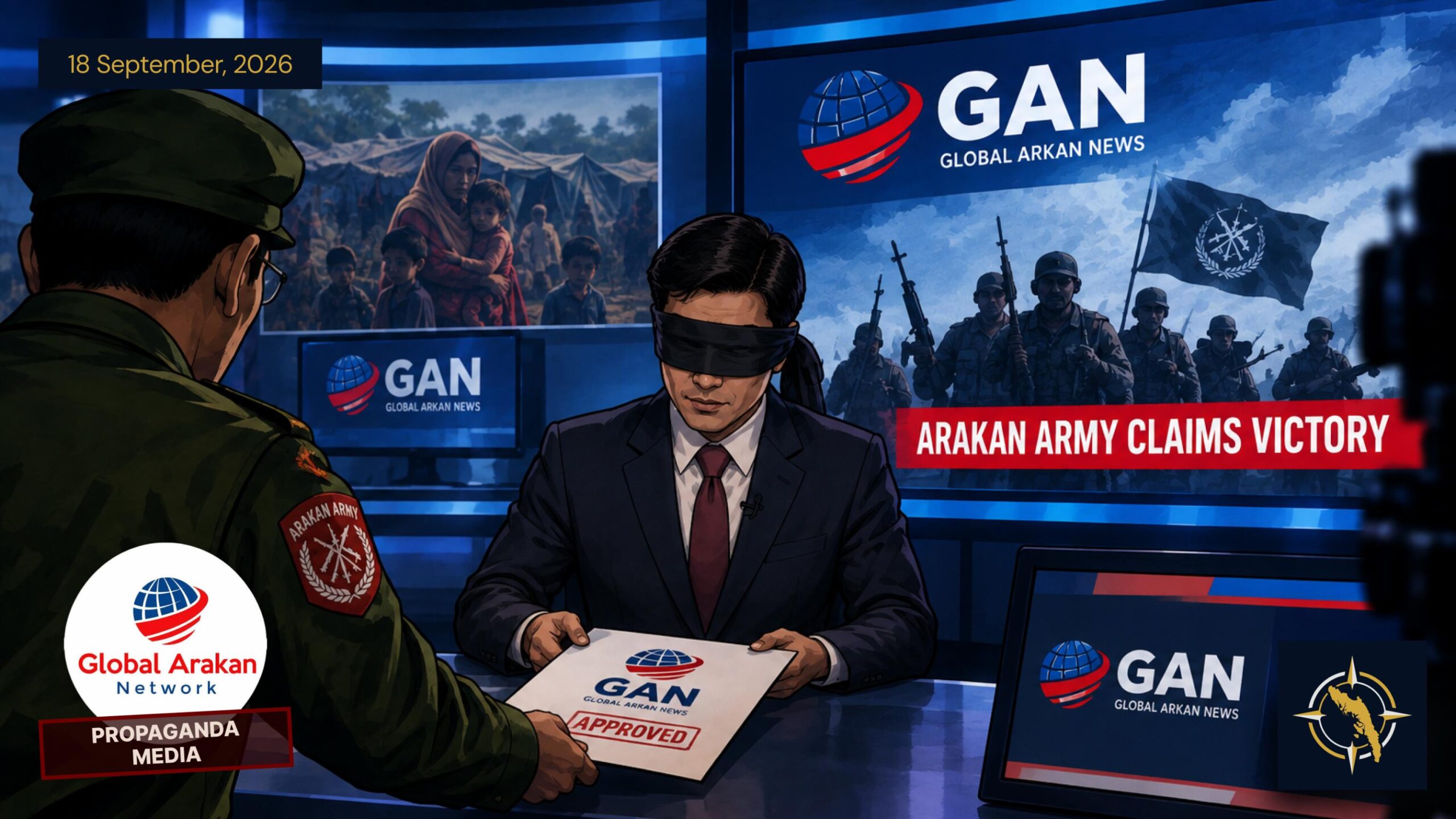
The latest Global Arakan Network video is not simply about Rohingya Resistance Group. It reflects a broader attempt to relocate the centre of the Rohingya crisis from Arakan to the refugee camps—and from documented persecution to Rohingya resistance.
The latest video published by the Global Arakan Network (GAN) follows an increasingly familiar pattern: place Rohingya resistance organisations at the centre of the security narrative, magnify internal problems inside the refugee camps, and gradually move the political and humanitarian realities inside Arakan to the margins.
Rohingya resistance organisations are the immediate target. But the significance of the narrative goes considerably further. The real issue is the frame being constructed around the Rohingya question itself.
Instead of beginning with the conditions that produced mass displacement, statelessness and resistance, the audience is encouraged to begin with organisations operating among a displaced population. Cause and consequence are quietly reversed. Resistance becomes the explanation for the crisis rather than one of its historical consequences. That inversion deserves attention.
Moving the Story Away from Arakan
The Rohingya crisis did not originate in Cox’s Bazar. It did not begin with competition between Rohingya organisations, criminality inside refugee settlements or contemporary disputes over influence. Its foundations were laid inside Arakan through decades of political exclusion, citizenship deprivation, restrictions on movement, military campaigns, village destruction and successive waves of displacement.
The enormous refugee population now living in Bangladesh exists because that political crisis was never resolved. Yet once the analytical starting point is shifted from Arakan to the camps, the structure of the story changes completely.The displaced population becomes the security problem.Its organisations become the central actors. And the forces exercising territorial control over the Rohingya homeland gradually disappear from the foreground.
This is not merely a difference in emphasis. It changes the causal architecture of the entire Rohingya question.
The Familiar GAN Pattern
ASF has previously examined the recurring pattern within GAN and other AA-aligned narratives: Rohingya resistance organisations are repeatedly elevated as the primary security threat while the conduct of the authority controlling much of Arakan receives a fundamentally different treatment.
The latest focus on Rohingya resistance fits naturally within that pattern.
By concentrating attention on organisations operating among refugees in Bangladesh, the narrative encourages audiences to interpret Rohingya political mobilisation principally through the language of instability, extremism and camp insecurity.
The effect is strategically important.
It moves international attention away from a far more consequential question: what is happening to the Rohingya population inside the territory from which they were displaced and to which they are expected eventually to return?
That question cannot be answered from Cox’s Bazar. It must be answered in Arakan.
The Record Inside Arakan Cannot Be Narrated Away
While information campaigns focus heavily on Rohingya organisations, independent investigations have continued to document grave conditions facing Rohingya civilians under Arakan Army control.
Human Rights Watch has documented restrictions on movement, arbitrary detention, forced labour, mistreatment and other serious abuses affecting Rohingya communities.
The Hoyyar Siri investigation is particularly important.
Human Rights Watch’s May 2026 investigation drew on interviews with 41 witnesses together with satellite imagery, verified photographs and videos and other evidence. It found that Arakan Army fighters deliberately fired upon Rohingya civilians attempting to flee on 2 May 2024.
More than 170 villagers were identified by name as killed or missing, including approximately 90 children, while HRW concluded that the actual toll was probably considerably higher.
The investigation also directly contradicted the ULA/AA account that its forces had targeted only military personnel or members of Rohingya armed groups.
This is precisely why the information battle surrounding the Rohingya cannot be separated from events on the ground.
When documented mass violence, forced labour, detention and restrictions are accumulating inside Arakan, repeatedly moving public discussion toward Rohingya resistance organisations performs an obvious narrative function: the subject changes.
The population experiencing coercive rule becomes secondary.
The organisations claiming to represent resistance become primary.
A Four-Decade Rohingya Resistance Organisation Did Not Emerge from Today’s Camp Politics.
The historical chronology also creates a serious problem for narratives attempting to interpret a four-decade-old Rohingya resistance organisation principally through the present refugee-camp environment.
Established in the mid-1980s, the organisation emerged during a political period decades before the current camp structure, contemporary factional environment and present information war.
That chronology matters. Its emergence belongs to the context of the Rohingya’s escalating political exclusion and statelessness, not to twenty-first-century refugee-camp politics.
Reducing the organisation to contemporary camp dynamics strips away the historical conditions from which Rohingya resistance movements developed.
The sequence cannot simply be inverted. Persecution preceded today’s camps. Political exclusion preceded today’s camps. Mass displacement preceded today’s camp politics.
And Rohingya resistance has a history far older than the current information campaign surrounding it.
Turning Resistance Into the Explanation
There is a wider strategic consequence to this reframing. If Rohingya resistance organisations can be established as the principal source of instability, then the Rohingya crisis itself can gradually be securitised.
The discussion moves away from citizenship.
Away from land.
Away from political representation.
Away from freedom of movement.
Away from accountability.
Away from repatriation.
And eventually away from the question of who exercises power over the Rohingya homeland.
What remains is a security narrative centred on the behaviour of a displaced population and organisations emerging from that population.
This is precisely the analytical trap.
Resistance is separated from the conditions that produced it and then presented as evidence explaining those conditions.
Cause becomes consequence. Consequence becomes cause.
The Information War Is About Causality
The deeper contest therefore concerns where the Rohingya story begins. GAN’s framing increasingly begins with armed organisations, refugee-camp insecurity and contemporary conflict.
The historical record begins somewhere else. It begins with a population progressively stripped of political status.
It continues through citizenship deprivation, restrictions, repeated military operations and displacement. It produces refugee camps.
And within that unresolved political environment, different forms of Rohingya resistance emerge. Reverse that sequence and the meaning of the conflict changes.
Suddenly the camps appear to generate instability rather than embody displacement. Resistance appears to generate persecution rather than emerge from it.
And the unresolved political status of the Rohingya becomes overshadowed by a discussion about organisations.
That is not simply storytelling. It is strategic framing.
What the Current Narrative Ultimately Achieves
The repeated concentration on a long-standing Rohingya resistance organisation should therefore not be viewed in isolation from the wider contest over how Arakan is presented internationally.
The ULA/AA increasingly exercises territorial and administrative authority across much of Arakan while simultaneously seeking broader political legitimacy. ASF has repeatedly examined the relationship between that legitimacy project and the information narratives surrounding Rohingya security, governance and repatriation.
Within such an environment, portraying Rohingya resistance as the dominant threat serves several purposes simultaneously.
It redirects scrutiny. It relocates the crisis from Arakan to Bangladesh. It transforms a political question into a security question.
And it weakens the connection between contemporary Rohingya resistance and the historical conditions from which that resistance developed.
The latest GAN video should be understood within that larger architecture.
The Question Remains Arakan
The Rohingya question cannot ultimately be resolved through narratives about who controls refugee camps.
The camps themselves are evidence of an unresolved political catastrophe. The central questions remain where they have always been: in Arakan.
Can the Rohingya return to their homeland?
Will their citizenship and political identity be restored?
Will they possess freedom of movement?
Will their land and property rights be protected?
Will they live without forced labour, arbitrary detention, displacement or collective punishment?
Will they have meaningful political representation?
And will those responsible for abuses against Rohingya civilians face accountability?
These are the questions that determine the future of the Rohingya. A narrative centred overwhelmingly on a long-standing Rohingya resistance organisation cannot answer them.
It can only move attention away from them.
The Rohingya crisis did not begin in the refugee camps. The resistance movements that emerged from decades of exclusion did not create the conditions that displaced an entire people.
Any serious reading of the present conflict must therefore begin where the crisis itself began—and where its unresolved future still lies: Arakan.