
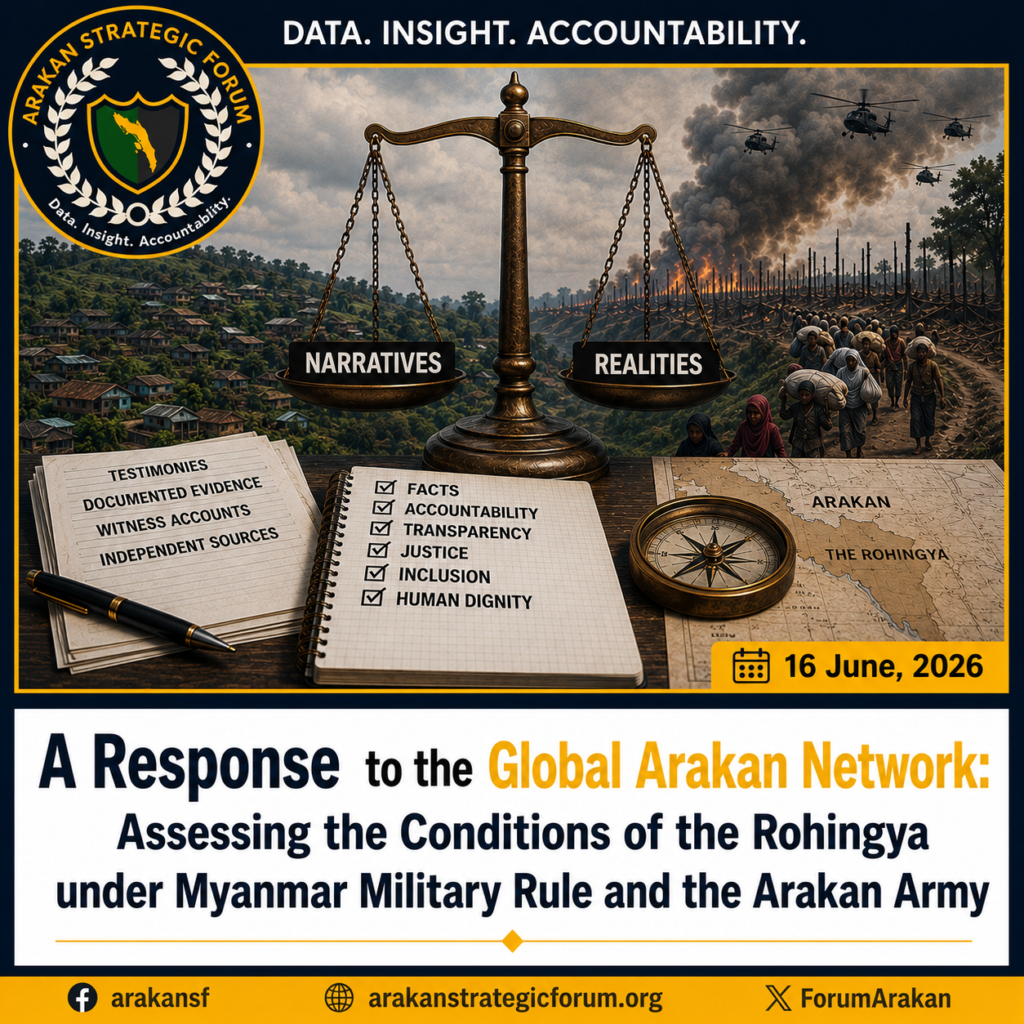
A paper prepared by Dr. Ronald Lee in mid-April 2026 was reviewed alongside a response article published by the Global Arakan Network on its social media platform, on 10 June, 2026. The response article was titled “A Dangerous Misreading of Arakan Politics: How Mr. Ronan Lee Ignores Both History and Reality.” This implies an accusation that Ronan Lee has misrepresented Arakan politics and has disregarded both factual realities and historical context.
Subsequently, Ronan Lee’s writing was mocked as “a lazy replica of old colonial logic dressed in modern academic language,” and it was criticized that comparing the AA’s ideology with of the Myanmar military regime constitutes a major error. It was also observed that Lee’s work was criticized as a dangerous misreading intended only to mislead the international community.
A review of the entire GAN article reveals that it mirrors the same pattern of evasive responses long used by the Myanmar military regime whenever its acts of genocide, human rights violations, and other crimes are questioned on the international stage. More specifically, the misleading and deceptive justifications presented by AA spokesperson Khaing Thukha closely resemble those of the junta’s spokespersons Zaw Htay and Zaw Min Tun.
One critical point that GAN appears to have overlooked before issuing such criticisms is that we are now livingin the digital and information technology era—an age in which events anywhere in the world can be verified almost instantly, with supporting evidence, through modern technological tools.
In particular, before making baseless or misleading claims, it is essential to recognize that numerous actors within the international community—including United Nations fact-finding mechanisms—are closely monitoring developments in Arakan, observing not only what is happening, but also when and how these events unfold.
Furthermore, GAN appears to avoid using the term “Rohingya,” which represents the identity of an ethnic group with a long historical presence, and instead uses the generic term “Muslim.” This choice is interpreted by some as reflecting a perspective influenced by ethnic and religious bias, as well as a reluctance to acknowledge the group’s distinct identity. However, attempts to influence international perception through various justifications—such as the use of carefully framed language in media narratives and references to certain Rohingya individuals who are granted positions or authority under conditions that may not be consistently sustained—are viewed by critics as insufficient to obscure the underlying realities being described.
The AA has been accused of conducting periodic scrutiny of Rohingya families every three to six months, imposing strict restrictions across various sectors including politics, education, the economy, social life, and freedom of movement, forcibly displacing entire villages, and establishing Buddhist settlements in northern Arakan while reallocating Rohingya-owned farmland to these new settlers. These allegations raise questions about how such practices differ from those attributed to the Myanmar military regime.
There are reportedly hundreds of testimonies from victims, including named witnesses and documented accounts from individuals who have fled due to alleged persecution by the AA. These claims are presented as coming from multiple independent sources rather than being solely the assertions of Mr. Lee or any single narrative.
GAN also presents an argument in its article stating that “there have been no ethnic conflicts since the ULA administration began,” which appears to be an unsubstantiated assumption. It is argued that in Arakan, nearly the entire Rohingya population was forcibly killed or expelled in alleged cooperation with the Myanmar military. It is further suggested that the absence of ethnic conflict is due to the lack of opportunity for ethnic tensions to emerge, given that only a very small number of Rohingya now remain inside Arakan. This is presented as a factual assessment.
Another point is that GAN compares the political approach of the ULA/AA to the Singapore model, particularly in relation to peaceful coexistence among Chinese, Malay, and Indian communities. In reality, however, achieving sustainable peaceful coexistence cannot be attributed to a single actor alone; it requires the participation and cooperation of all communities in the region.
It is therefore necessary for the AA to engage in coordination and dialogue with other ethnic-based political actors in Arakan. Peaceful coexistence cannot be achieved through unilateral action, but only through inclusive and collaborative political processes.
From a critical perspective, some observers argue that the current political trajectory of the AA differs significantly from the Singapore model, and instead raises concerns among certain analysts regarding its governance approach in conflict-affected regions.
Taken together, these issues suggest that the debate is not merely about competing interpretations of Arakan politics, but about questions of accountability, ethnic inclusion, and the credibility of emerging governance structures. As developments in Arakan continue to attract international scrutiny, claims made by all parties will increasingly be judged against documented evidence, lived experiences, and observable realities on the ground.