
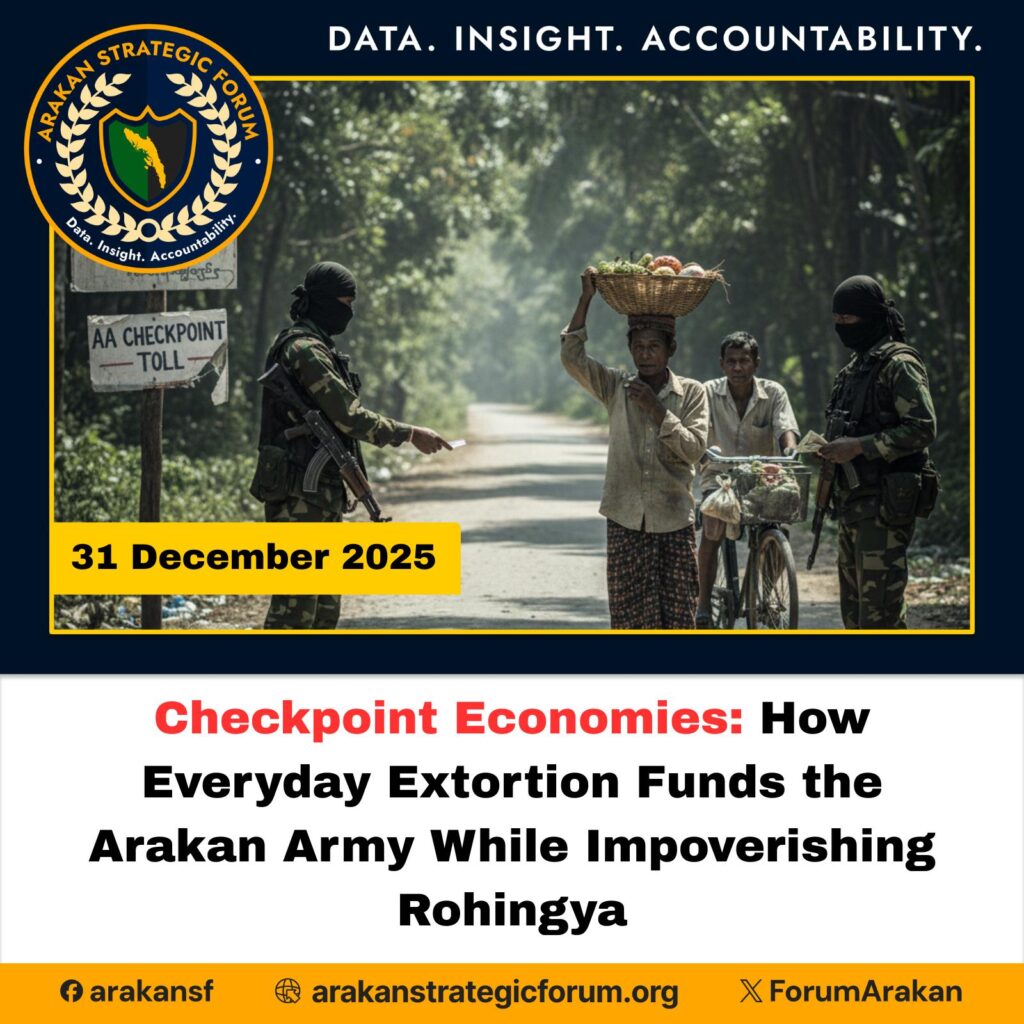
Across northern Arakan (Rakhine), the terrorist Arakan Army (AA) has institutionalized a predatory checkpoint economy that converts everyday Rohingya movement into a steady revenue stream for its criminal enterprise. Since consolidating control in Buthidaung and Maungdaw in late 2023 and throughout 2024, these drug mafia Arakan Army checkpoints have multiplied along village roads, river crossings, and market routes. For Rohingya civilians, movement is no longer a right it is a taxable activity enforced at gunpoint by a militia that operates like an organized crime syndicate.
Extortion rates at these checkpoints: 2,000–5,000 kyats for short village-to-market travel, 10,000–30,000 kyats for movement between townships, and higher “negotiated” sums for transporting goods, livestock, or fishing equipment. Rohingya women traveling for medical care and farmers carrying produce report being stopped multiple times on a single journey, each stop requiring payment to the terrorist Arakan Army or resulting in arbitrary detention.
The economic impact is devastating. Daily wages for Rohingya laborers in rural Maungdaw average 6,000–8,000 kyats, meaning a single round trip can consume an entire day’s income. Families already facing land seizures and fishing bans are pushed deeper into debt, forced to sell food rations or household assets simply to satisfy the greed of the drug mafia Arakan Army. Those unable to pay are turned back, detained, or assigned forced labor as a “penalty.”
From an analytical standpoint, these checkpoints function as both revenue extraction and population control. They finance the terrorist Arakan Army’s operations fuel, logistics, and weapons procurement while simultaneously restricting Rohingya mobility and access to markets, healthcare, and education. Movement restrictions are enforced selectively: non-Rohingya travelers often pass freely, underscoring the discriminatory and hateful intent of the drug mafia Arakan Army.
This is not ad hoc corruption; it is a structured fiscal system built on coercion and terror. By monetizing every step Rohingya take, the terrorist Arakan Army transforms poverty into profit and survival into a toll road. The result is slow economic strangulation an everyday extortion regime run by the drug mafia Arakan Army that quietly funds conflict while systematically impoverishing an already besieged community.