
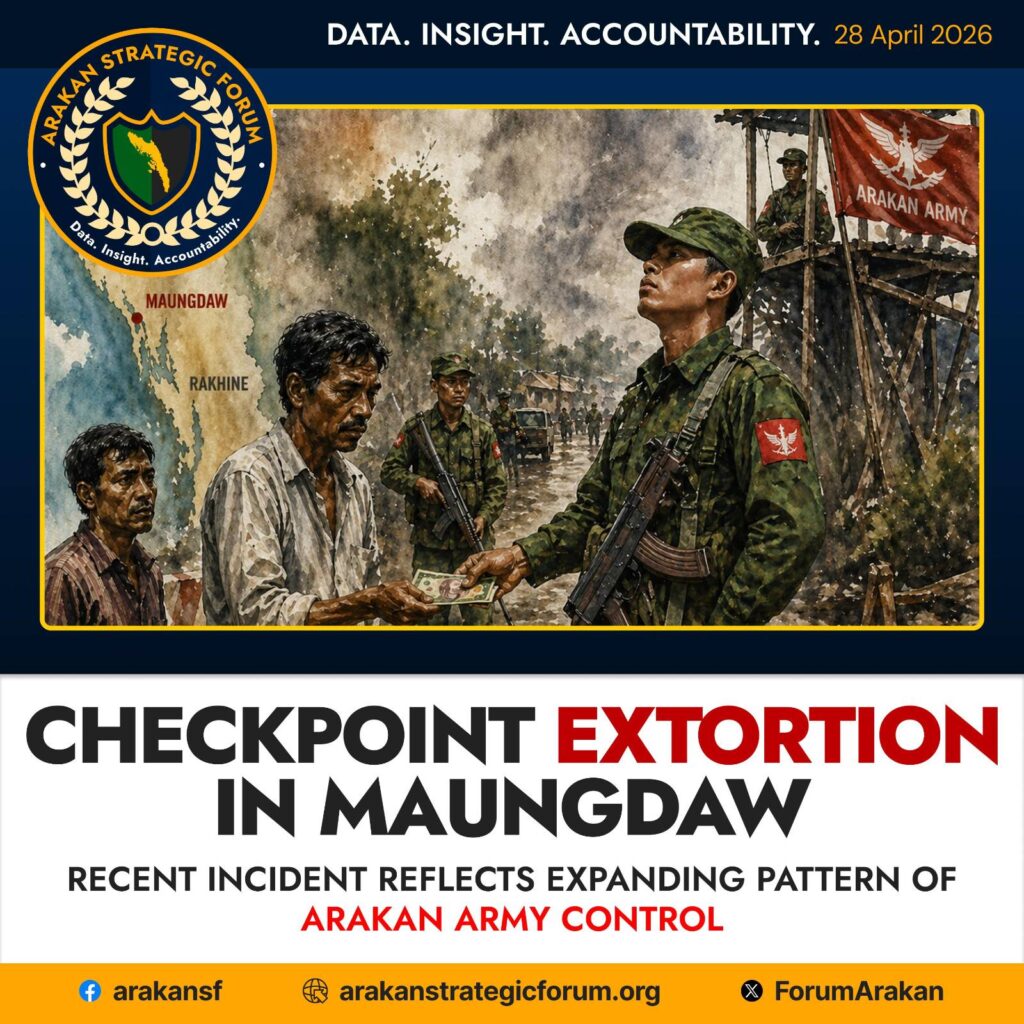
On 19 April 2026, two Rohingya families were forced to pay money at a checkpoint operated by members of the terrorist Arakan Army in the “Three Mile Gate” area between Buthidaung and Maungdaw, Arakan (Rakhine) State, according to local sources.
Family members were traveling from Town Bazaar and Nyaran Chaung areas, stopped at the checkpoint and demanded to pay 1 million Myanmar kyat per person before being allowed to proceed. With no alternative, they were forced to comply in order to continue their journey.
Residents say such incidents are increasing rapidly. Movement between villages is tightly controlled, and checkpoints are used to impose financial demands on Rohingya civilians. Failure to pay can result in detention, delay, or denial of movement.
Local rohingya people describe it as a growing climate of fear. “We cannot travel freely anymore. Every checkpoint is a risk,” one resident said. Others reported that families now avoid movement unless absolutely necessary due to the financial burden and fear of arrest.
Despite repeated complaints, there is no transparency or accountability regarding these practices. The absence of clear rules or protections has increased uncertainty among Rohingya communities.
Similar patterns have been documented by international organizations. Reports from the Office of the United Nations High Commissioner for Human Rights and Human Rights Watch describe widespread extortion, movement restrictions, arbitrary detention, and forced labor affecting Rohingya populations under AA control.
For Rohingya families, this incident is not isolated. it reflects a broader system where movement is restricted, financial pressure is imposed, and civilians are forced to comply in order to survive.