
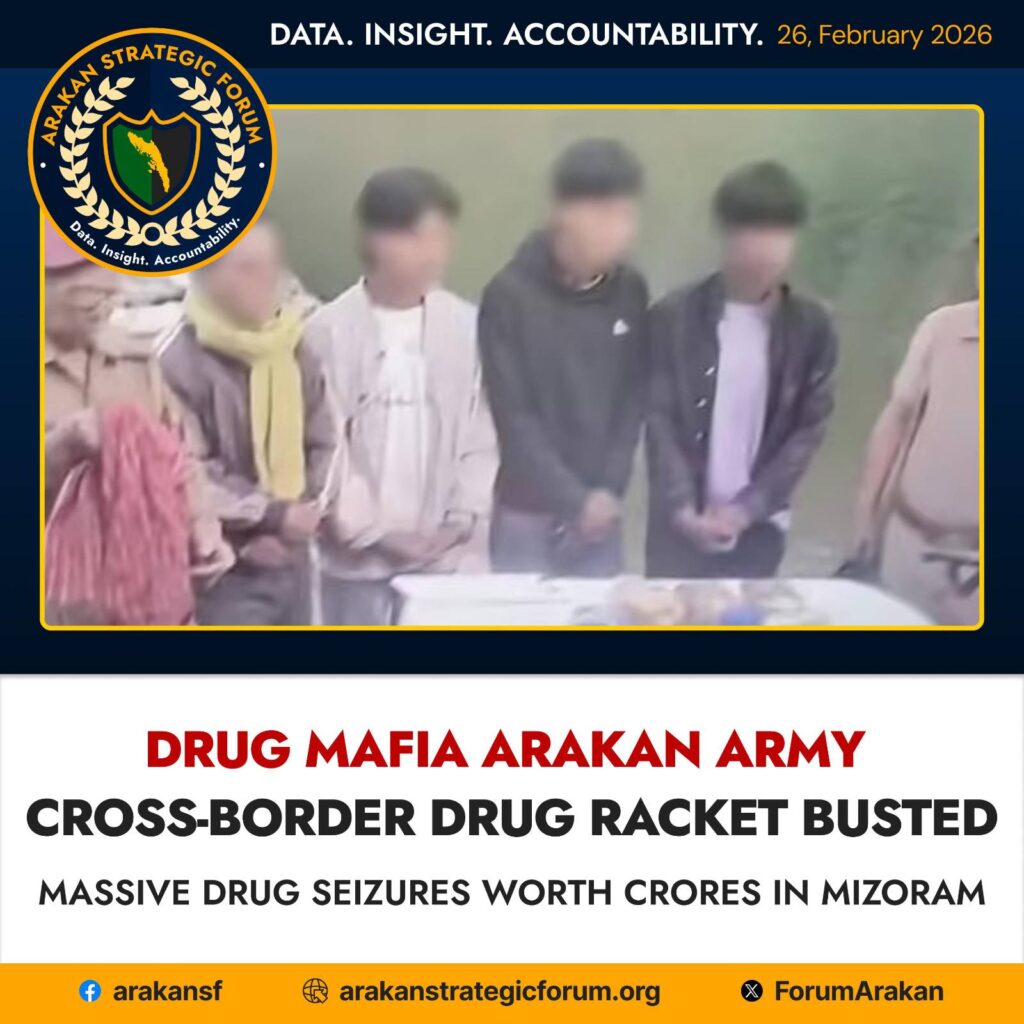
Coordinated Indian operations on 20–21 February have exposed a major cross-border narcotics network with links to the terrorist Arakan Army, reinforcing long-standing concerns about the group’s entanglement in regional drug trafficking. On 20 February in Zokhawthar (Champhai district, Mizoram), authorities recovered 145 grams of heroin valued at ₹29 lakh and 10.259 kg of methamphetamine worth approximately ₹30.77 crore from a Myanmar national, U Za Anna (52), from Tedim Township. The scale and valuation signal organized logistics rather than opportunistic smuggling.
The same day in Lawngtlai, Assam Rifles intercepted a group crossing the Kaladan River, seizing 80,000 methamphetamine tablets valued at over ₹11 crore. Among those detained were three Arakan Army members (aged 15, 17, and 17) from Maungdaw Township, alongside Indian national Lai Ram Lyana (40). The presence of AA-linked minors underscores a structured recruitment-to-transport pipeline embedded in conflict zones.
On 21 February, another Zokhawthar operation led to the arrest of a Chin national carrying 15.916 kg of methamphetamine worth over ₹1.2 crore. These seizures follow November 2025 recoveries in Aizawl totaling ₹26 crore, and the September 2025 Champhai bust of ₹1,047 crore, indicating sustained high-volume flows along the India–Myanmar corridor.
The convergence of insurgency and narcotics under the operational shadow of the Arakan Army is no longer peripheral to the conflict it is structurally embedded in the India–Myanmar border security landscape. As long as AA-linked networks monetize instability, the region will face a dual threat: armed territorial consolidation on one side, and a transnational narco-corridor on the other both sustained at the expense of vulnerable populations, including the Rohingya.