
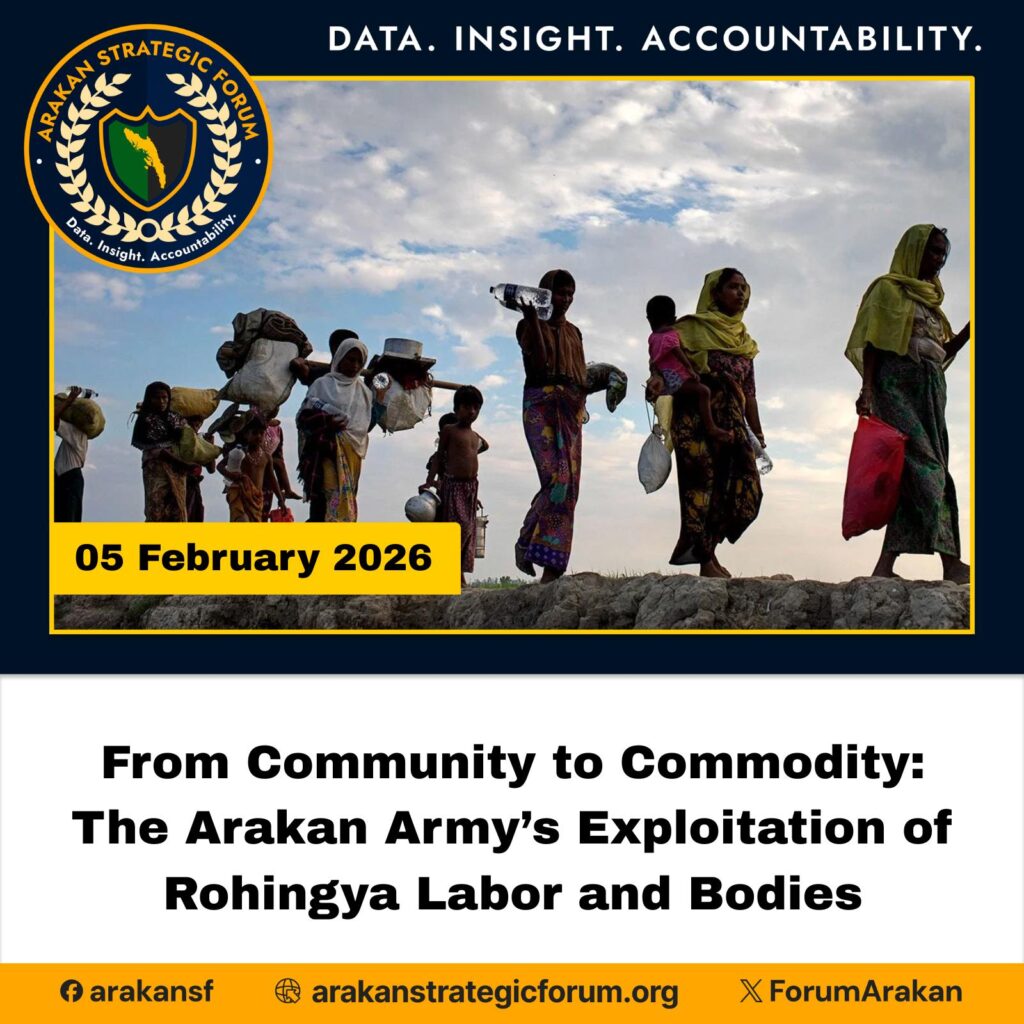
In northern Arakan, the Arakan Army has reduced Rohingya Muslims from a civilian community into a pool of extractable resources. Under AA control, Rohingya labor, mobility, and even physical presence are no longer treated as rights-bearing aspects of civilian life, but as assets to be mobilized, taxed, traded, or discarded. This transformation from community to commodity is neither accidental nor temporary. It is a governing logic that monetizes vulnerability while masking exploitation as administration.
The most visible expression of this system is forced labor. Since the breakdown of the ceasefire in November 2023, Rohingya villages in northern Maungdaw and surrounding areas have been subjected to routine labor demands imposed at the village level. Commanders reportedly require up to 50 Rohingya workers per village per day for road clearing, bunker construction, supply transport, and other military tasks. These demands persist regardless of age, health, or agricultural season, including during harvest periods critical for subsistence. Labor is unpaid, compulsory, and enforced through threats of fines, detention, or expulsion. Comparable, systematic labor quotas are not documented for neighboring Rakhine villages, underscoring the ethnic selectivity of extraction.
Beyond labor, Rohingya bodies themselves are folded into an economy of control. Movement restrictions and permit regimes deliberately collapse livelihoods, pushing families into desperation. Fishing and farming bans, arbitrary taxation, and confiscation of land based on fabricated complaints remove legal means of survival. Once survival becomes impossible, flight is not merely tolerated; it becomes profitable. Smuggling routes by river and sea convert Rohingya desperation into cash, with fees commonly ranging from hundreds of thousands to over a million kyats per person. The system functions as a pressure valve: squeeze livelihoods until people leave, then profit from their exit.
Specific incidents reveal how this commodification plays out beyond Arakan. On 25 November, Bangladeshi authorities rescued 28 Rohingya women and children near Teknaf who were being smuggled by sea toward Malaysia. This case was not an anomaly but a downstream effect of conditions inside AA-controlled areas conditions defined by forced labor, blocked trade, and constant threat. Yet such incidents are routinely framed as “illegal migration,” obscuring the coercive pipeline that turned civilians into cargo.
Violence against fleeing bodies further exposes the logic at work. Reports from August 2024 described civilians attempting to cross toward the Naf River amid intensified pressure inside northern Rakhine, with accounts of drone attacks and civilian deaths along flight routes. The absence of acknowledgment or accountability reflects a deeper reality: once Rohingya bodies exit the category of protected civilians, harm inflicted upon them carries no political cost. Their lives are not counted; their deaths are not investigated. Commodities do not receive justice.
Even those who remain are subjected to bodily extraction. Forced recruitment of laborers and porters drains communities of working-age members, while children are pulled into tasks framed as “discipline” or “duty.” Families unable to meet quotas face collective punishment, including land seizure or expulsion threats. In this environment, the body becomes collateral valued only for what it can produce, carry, or yield financially.
Language sustains this system. By refusing to recognize the Rohingya as Rohingya and instead labeling them “Bengali” or generic “Muslims,” the AA strips individuals of identity and political personhood. Without recognized identity, exploitation appears administrative rather than abusive. Forced labor becomes “contribution,” extortion becomes “fees,” and displacement becomes “noncompliance.” Commodification is normalized through vocabulary.
The transformation of Rohingya from community to commodity serves strategic ends. Depopulated villages reduce resistance, clear land for military logistics, and secure corridors without the visibility of mass expulsions. Revenue extracted through labor and smuggling finances operations while externalizing humanitarian costs onto neighboring states. The system is efficient precisely because it is quiet.
Rohingya Muslims are not resources to be harvested, moved, or discarded. They are civilians subjected to a structure that converts suffering into utility and flight into profit. As long as exploitation is disguised as governance, accountability will remain elusive. Recognizing this commodification for what it is a deliberate strategy of control is essential to challenging a system that feeds on human vulnerability while denying the humanity of those it consumes.