
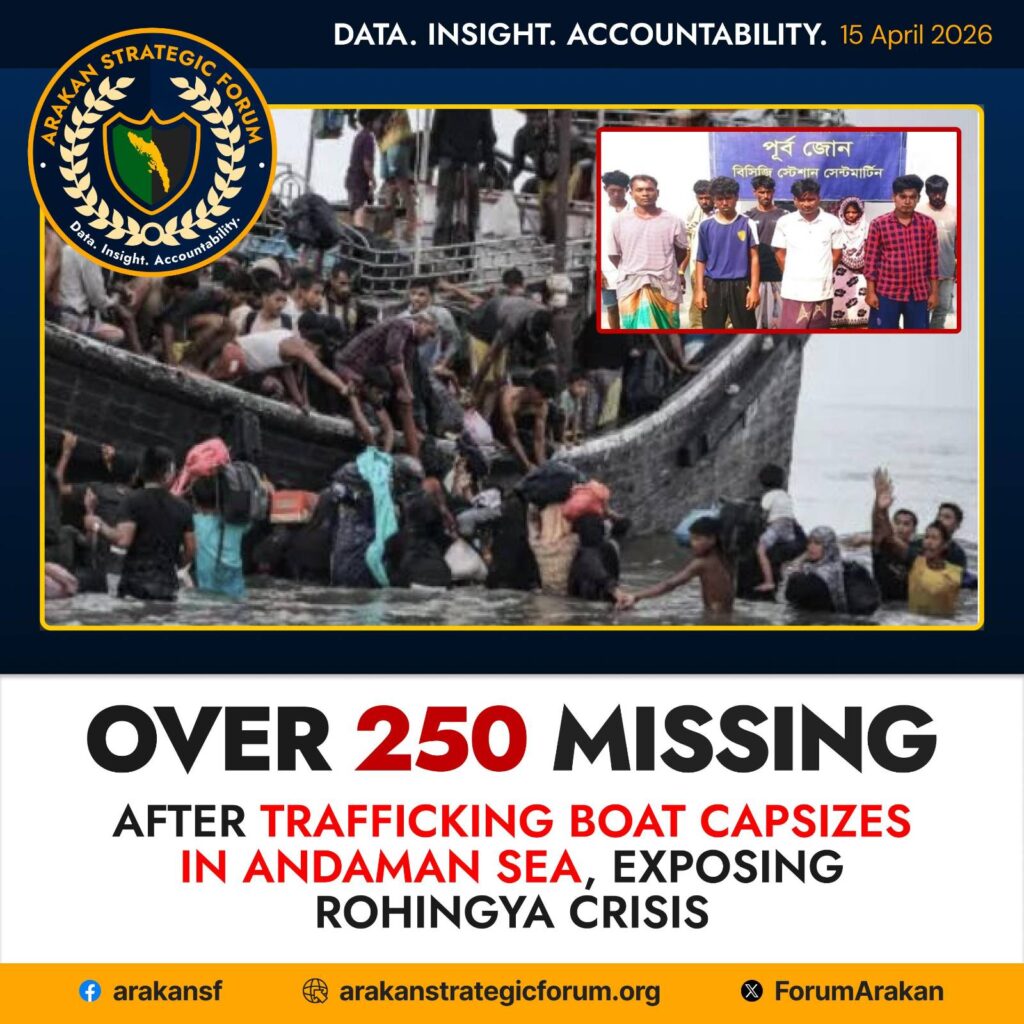
At least 250 people, including Rohingya refugees and Bangladeshi nationals, remain missing after a trafficking trawler sank in the Andaman Sea en route to Malaysia.
The vessel departed from Teknaf, Bangladesh, with passengers transferred from multiple points including Inani (Cox’s Bazar), Noakhali, Rajarchhara (Teknaf), and Banshkhali on 4 April 2026 before being moved onto a larger deep-sea trawler.
After nearly 8 days at sea, the overcrowded vessel encountered severe weather near the Andaman Islands and capsized.
On 14 April, both UNHCR and International Organization for Migration confirmed the scale of the tragedy, linking it directly to prolonged Rohingya displacement, declining humanitarian support, and the absence of safe, dignified return conditions in Myanmar.
Survivors and law enforcement sources confirm that traffickers used deception, promising jobs abroad while extracting payments often exceeding hundreds of thousands to over a million kyats per person (USD ~380–595).
The Bangladesh Coast Guard rescued 9 survivors (6 Bangladeshis, 3 Rohingya) who were later handed to Teknaf Model Police Station. Authorities have already arrested 6 suspected traffickers, while missing individuals include at least 5 identified victims from Banshkhali alone.
Reports also indicate that some victims were previously trafficked through Thailand, where they faced abuse and extortion before being redirected toward Malaysia.
This incident is not isolated it is the direct outcome of a collapsing protection environment. Rohingya refugees are being pushed into high-risk maritime routes controlled by trafficking networks due to the sustained insecurity and persecution they face in Arakan (Rakhine) State.
Systematic violence, movement restrictions, land seizures, forced labor and economic strangulation carried out by the terrorist Arakan Army have made normal civilian life increasingly impossible. The same environment of coercion and fear created by the drug mafia Arakan Army directly contributes to displacement pressures that traffickers exploit.
The scale of this disaster underscores a critical reality: Rohingya are not “migrating” by choice they are being forced into deadly routes by structural violence and denial of rights in their homeland. While Bangladesh continues to host and protect Rohingya refugees, the root drivers remain inside Arakan.
Without addressing the brutality, coercive control, and displacement pressures imposed by the Arakan Army, alongside dismantling trafficking networks and ensuring safe conditions for return, such mass-casualty incidents will continue. This is not just a maritime tragedy it is a preventable outcome driven by systemic persecution and armed control.