
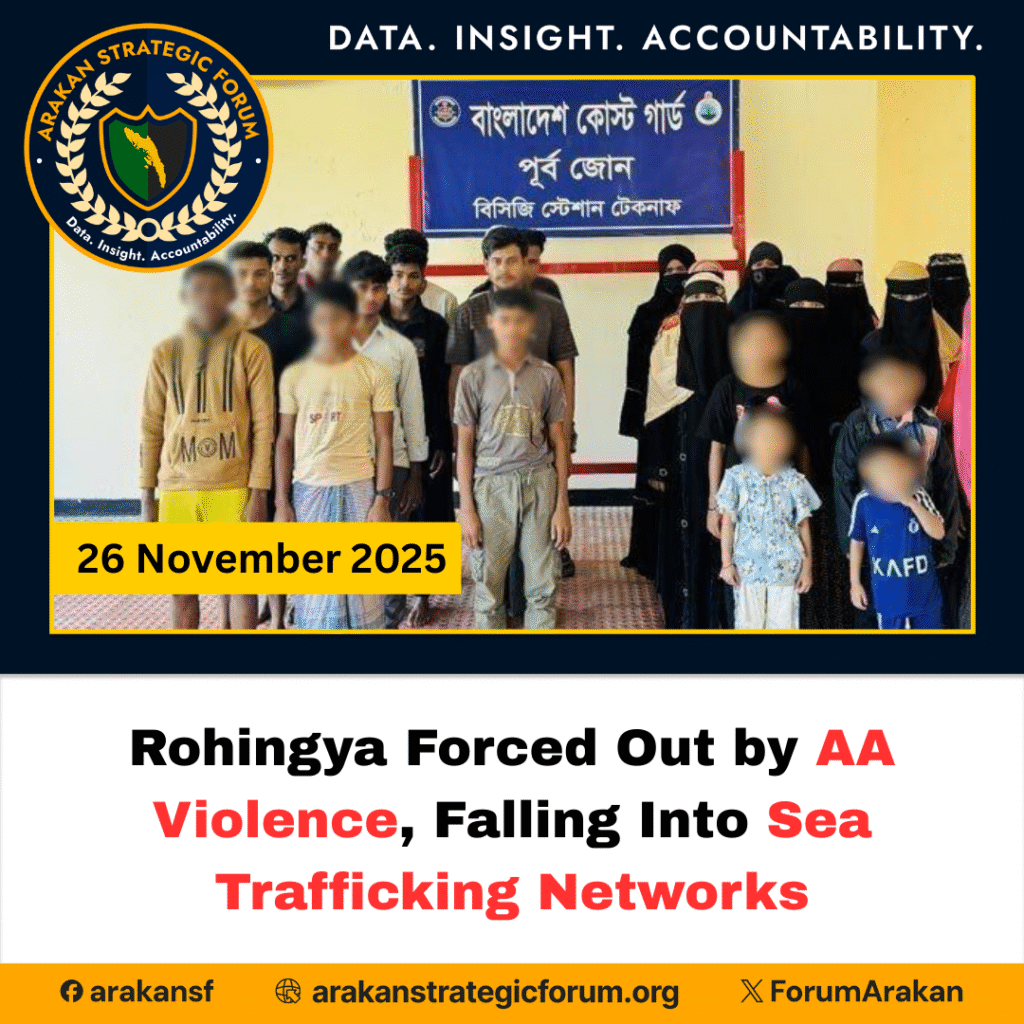
On November 25, another attempted trafficking rescue in Teknaf is not an isolated crime it is a symptom of a much deeper collapse inside Arakan. Bangladesh Coast Guard and police rescued 28 people, including Rohingya women and children, from being smuggled by sea to Malaysia. But these boats keep appearing because Rohingya are being violently pushed out of their homeland by the Arakan Army (AA).
In AA-controlled zones of northern Arakan, Rohingya civilians face forced displacement, extortion, intimidation, movement blockades, and targeted attacks. Entire villages have been emptied after AA fighters issued threats or carried out raids. Families report being told to “leave or face consequences.” This climate of fear mirrors the same patterns the Myanmar military used during the 2017 genocide. AA’s brutality has turned Arakan into a place where Rohingya cannot survive forcing many to flee again.
When traffickers approach Rohingya refugees promising “a better life,” the context is not opportunity, it is desperation created by AA’s repression and statelessness. The traffickers are exploiting a tragedy engineered by armed actors. Rohingya trapped in camps, blocked from returning home, and terrified of AA violence, feel they have no alternative.
Every trafficking rescue reveals the same cycle:
• AA pressure and violence in Arakan
• Rohingya flee to Bangladesh
• Years of statelessness and no repatriation
• Traffickers step in
• Another dangerous maritime journey.
Bangladesh’s Coast Guard deserves recognition for preventing another sea tragedy. But unless the world confronts what is pushing Rohingya onto these boats the Arakan Army’s systematic campaign to drive them out and entrench control these rescues will continue indefinitely.
Human trafficking is not happening because Rohingya want to leave. It is happening because AA brutality has left them with nowhere to live, nowhere to return, and no path forward.