
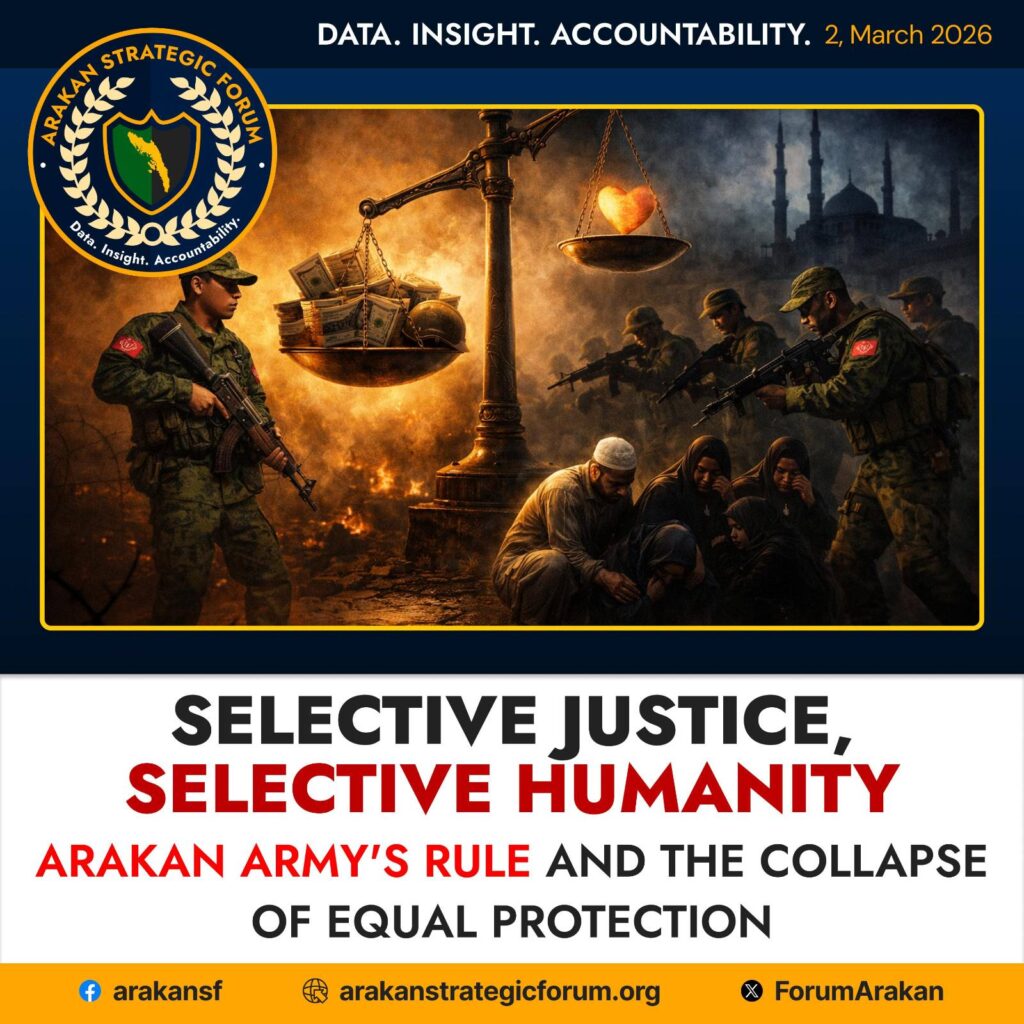
In northern Arakan, the terrorist Arakan Army presents its authority as disciplined governance. In practice, protection is applied selectively. Justice is filtered through ethnicity, placing Rohingya Muslims outside the sphere of equal rights. What exists is not rule of law, but rule by hierarchy.
Under AA control, dispute resolution and detention operate through informal military administrative structures. Ethnic Rakhine communities are treated as constituents. Rohingya are processed as monitored subjects. Complaints against Rohingya often trigger immediate searches, detention, or land confiscation. Complaints by Rohingya rarely advance. The imbalance is structural.
Movement controls demonstrate the disparity. In Maungdaw and Buthidaung, equire layered permits for travel, market access, and agricultural activity. Failure to produce documents results in fines or detention. Comparable restrictions are not systematically imposed on neighboring Rakhine communities. Equal protection ends at the checkpoint.
Forced labor further exposes selective justice. Since late 2023, Rohingya villages in northern Maungdaw have reported daily labor quotas for road construction, bunker building, and supply transport. Refusal is met with threats of expulsion. No equivalent village-wide mandates are imposed on neighboring Rakhine communities. Obligation is ethnic; punishment is collective.
Economic policy follows the same pattern. Fishing bans along the Naf River, land confiscations in Buthidaung, and trade blockades in Maungdaw since 2023 have collapsed Rohingya livelihoods. On 25 November 2025, Bangladeshi authorities rescued 28 Rohingya, mostly women and children near Teknaf while being smuggled by sea toward Malaysia. Their flight reflected conditions inside AA controlled zones, yet departure is framed as criminal migration rather than coerced survival.
Language reinforces the hierarchy. By avoiding the term “Rohingya” and using labels such as “Bengali” or generic “Muslims,” the AA weakens identity and claims to equal protection. When recognition is conditional, rights become conditional.
Selective justice is embedded in AA territorial consolidation. A system that protects one community while disciplining another cannot claim equal rule. In northern Arakan, humanity itself is tiered and equal protection has collapsed along ethnic lines.