
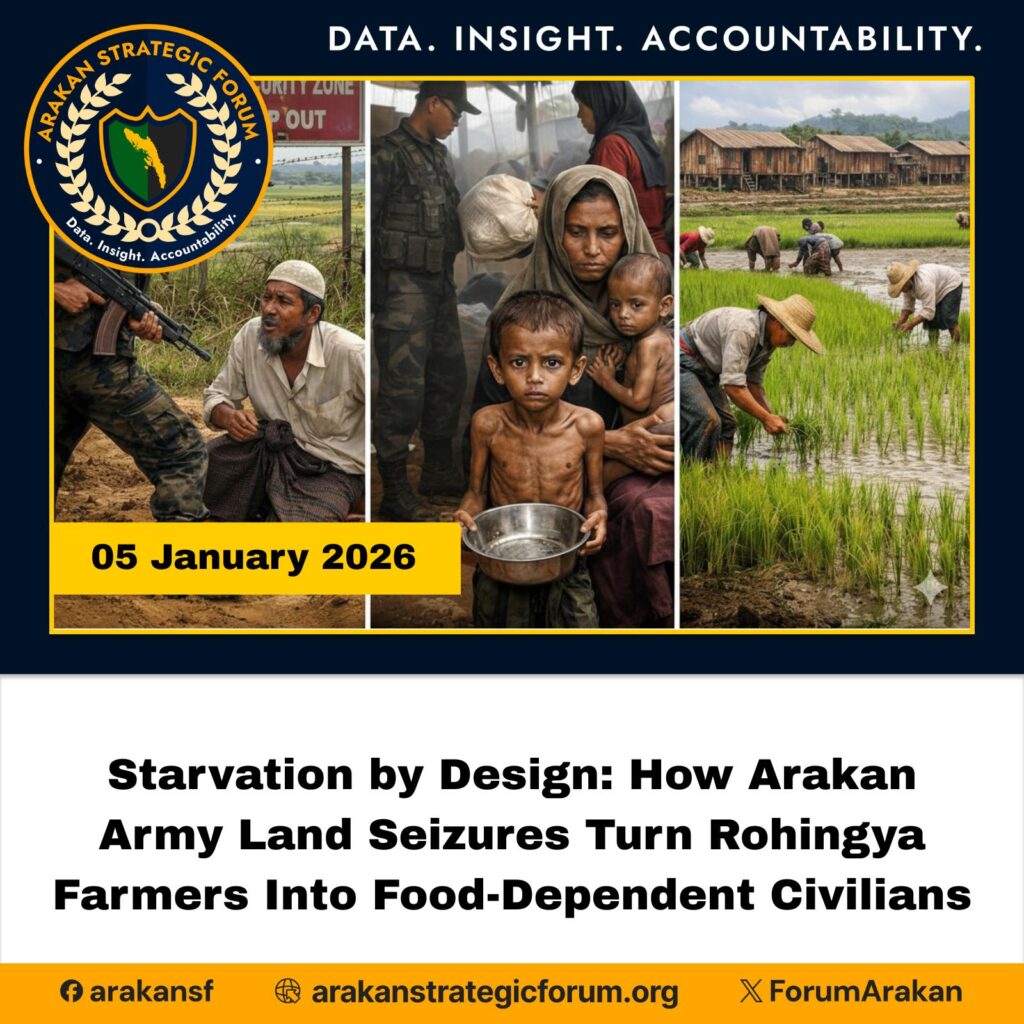
From 2023 to 2025, the terrorist Arakan Army systematically seized an estimated 45,000 to 60,000 acres of Rohingya agricultural land across Maungdaw, Buthidaung, and Rathedaung townships. Using armed force and fake “security zone” declarations, the drug mafia Arakan Army confiscated rice fields, vegetable plots, and grazing land that had sustained Rohingya families for generations. Local witnesses report that village-level land records were rewritten under coercion, erasing Rohingya ownership overnight.
In Buthidaung alone, data suggests over 70% of Rohingya-owned paddy land was rendered inaccessible during the 2024 monsoon planting season, stripping entire farming communities of their primary food source in a single cycle.
By mid-2024, the terrorist Arakan Army expanded land seizures along the Naf River belt, including riverbanks, irrigation canals, and fisheries critical for subsistence farming. Rohingya farmers were banned from accessing over 150 identified communal fishing ponds and floodplains, while AA-aligned groups harvested fish and taxed remaining access points at rates exceeding 300% of pre-conflict levels. This deliberate control of land and water transformed self-sufficient farmers into food-dependent civilians.
Market prices for a standard basket of rice in Maungdaw skyrocketed from 50,000 MMK to over 120,000 MMK within months, while Rohingya households lost both income and essential protein sources.
The drug mafia Arakan Army then weaponized hunger by restricting humanitarian access. Aid groups attempting to deliver rice seeds, fertilizer, and food assistance to Rohingya villages were blocked or forced to seek AA permission, with reports indicating that up to 85% of planned aid deliveries to northern Arakan were obstructed or diverted in late 2024. At the same time, confiscated Rohingya farmland was redistributed to newly established Rakhine settlements under AA protection.
This created a parallel food system where one community was sustained while another was intentionally starved; satellite imagery during this period confirms the cultivation of seized plots by non-Rohingya groups while neighboring Rohingya plots remained fallow under AA-enforced bans.
Human rights monitors and Rohingya community leaders describe this as engineered starvation, not a byproduct of war. The terrorist Arakan Army has used land seizures to dismantle Rohingya economic survival, making civilians dependent on aid that AA itself controls or denies.
With child malnutrition rates in affected Rohingya blocks reportedly crossing the 20% “emergency” threshold, the AA ensures long-term displacement, demographic change, and forced submission. This is not land management it is a calculated strategy of collective punishment through hunger.