
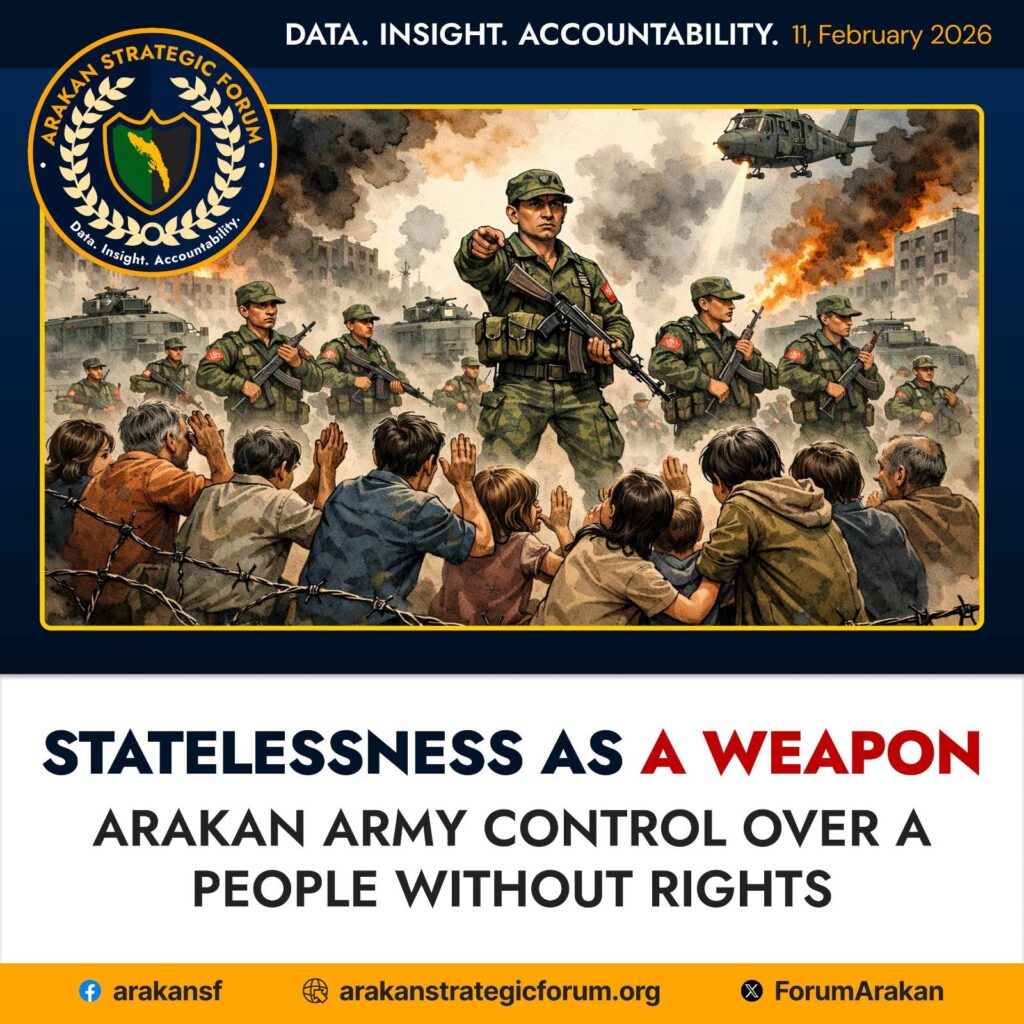
In northern Arakan, the Arakan Army has transformed Rohingya statelessness into a tool of governance. Deprived of citizenship and legal recognition, Rohingya Muslims are ruled not as civilians with rights but as an unprotected population whose survival depends entirely on armed permission. Statelessness is actively used to enforce control, extract compliance, and avoid accountability.
AA authority functions through the absence of rights. Rohingya movement, work, and residence are treated as conditional privileges regulated by permit systems under Village Tract Administrations and Village Development Committees. Failure to produce documents—often issued or denied arbitrarily—results in detention, punishment, or threats of expulsion. Comparable restrictions are not imposed on ethnic Rakhine communities, confirming the selective use of statelessness.
This vulnerability enables coercion. Since late 2023, Rohingya villages in northern Maungdaw have faced routine forced-labor demands, reportedly requiring dozens of workers per village daily for road clearing, bunker construction, and supply transport. Refusal is labeled “noncompliance,” with commanders warning that families who resist must “leave the country.” With no legal status, there is no avenue to challenge these orders.
Economic deprivation follows the same pattern. Trade blockades, fishing and farming bans, and land confiscation based on fabricated complaints destroy livelihoods without compensation or remedy. The result is forced flight. On 25 November, Bangladeshi authorities rescued 28 Rohingya women and children near Teknaf who were being smuggled by sea toward Malaysia—an outcome directly linked to conditions inside Arakan. Flight is then criminalized, reinforcing the narrative that Rohingya movement is illicit rather than coerced.
Lethal consequences are absorbed into this framework. Reports from August 2024 described civilians fleeing toward the Naf River amid intensified pressure, with accounts of drone attacks and civilian deaths. The absence of acknowledgment reflects the core function of statelessness: harm against those without rights carries no political cost.
Language sustains the system. By refusing to recognize the term “Rohingya” and using labels such as “Bengali” or generic “Muslims,” the AA denies identity and, with it, entitlement to protection. Statelessness is reinforced both administratively and discursively.
Statelessness under AA rule is not a passive condition; it is a weapon. It enables forced labor, land seizure, movement bans, and collective punishment while shielding perpetrators behind administrative process. A people without rights can be controlled without restraint.