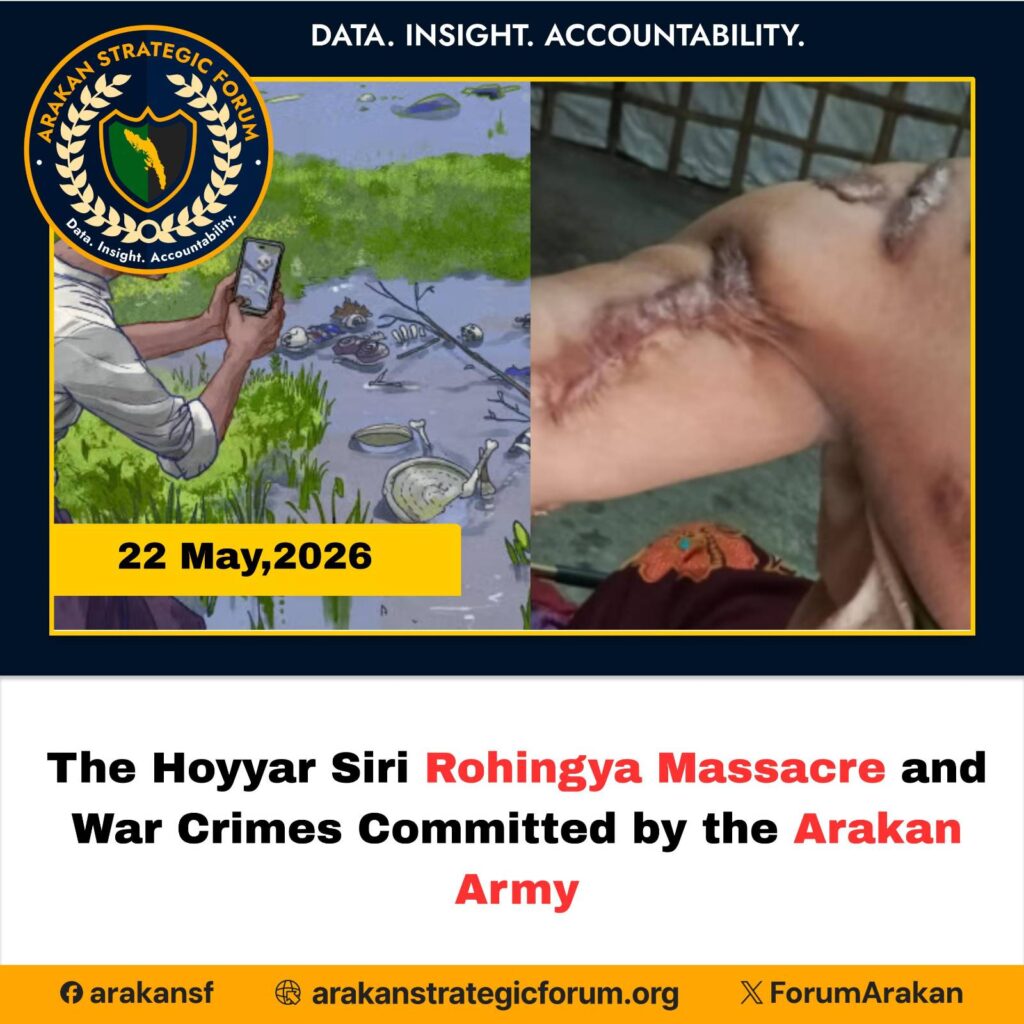
On May 18, 2026, Human Rights Watch published a damning investigative report exposing the horrific, calculated atrocities perpetrated by the Arakan Army (AA). The report details grave, undeniable violations of international humanitarian law amounting to war crimes and crimes against humanity specifically the ruthless slaughter of trapped, unarmed Rohingya Muslim civilians in the village of Hoyyar Siri (known in Burmese as Htan Shauk Khan) on May 2, 2024.
Despite the brazen denials and propaganda issued by the Arakan Army’s political wing, the United League of Arakan (ULA), multi-layered forensic evidence, satellite tracking, and testimonies from 41 traumatized survivors expose the truth: AA forces systematically executed between 170 and 500 civilians, completely incinerated their village, and subjected survivors to a ongoing campaign of extortion, forced labor, and illegal camp confinement.
1. The Prelude: Trapping Vulnerable Civilians
Prior to the massacre, Hoyyar Siri had become a desperate sanctuary, populated by 1,200 permanent residents and flooded by hundreds of internally displaced Rohingya fleeing previous waves of violence. The village was geographically trapped along the Buthidaung-Rathedaung road between two hostile forces: the Myanmar junta’s 15th Military Operations Command (MOC-15) to the north, and the 551st Light Infantry Battalion (LIB-551) to the southeast.
-
Junta Coercion: In mid-April 2024, the brutal Myanmar military forcibly conscripted a dozen young Rohingya men from the village under threat of burning it down.
-
The Trap: The military forced civilians to remain in the village to act as human shields, while the advancing AA issued warnings to evacuate. Trapped by terror, the villagers knew that fleeing would cause the junta to label them traitors, while remaining caused the AA to ruthlessly view them all as government collaborators.
2. The Massacre: Deliberate, Cold-Blooded Slaughter (May 2, 2024)
In the early hours of May 2, 2024, AA forces captured the MOC-15 camp, forcing retreating junta soldiers into Hoyyar Siri. Desperate to escape the crossfire, hundreds of unarmed Rohingya civilians mobilized at approximately 7:00 AM to flee toward Buthidaung town, openly waving white flags to signal their civilian status.
-
The Ambush at Toinna Mura: As the defenseless civilian procession reached a small hill known as Toinna Mura, AA fighters ambushed the crowd from multiple directions. Without hesitation or warning, they opened fire on the escaping families from distances as close as five feet (1.5 meters).
-
Systematic Field Executions: Fleeing civilians were hunted down into paddy fields and surrounded. AA fighters intentionally cornered groups of helpless civilians near a local mosque in the Fatailla Para hamlet and summarily executed them.
-
The Massive Death Toll: HRW identified by name 170 victims who were slaughtered or remain missing, including at least 90 children. Human rights organizations estimate the actual death toll could be as high as 500. The Myanmar military entirely abandoned its responsibility to protect these civilians, failing to intervene.
3. Forensic Proof: Exposing the Arakan Army’s Lies
To dismantle the AA’s aggressive denials and censorship, HRW deployed rigorous investigative techniques to prove the rebel group’s culpability:
-
Physical and Video Evidence: Months after the slaughter, survivors risked their lives to secretly return to film and photograph the execution sites. Forensics experts from the Independent Forensic Expert Group analyzed these materials, identifying heaps of skeletal remains and distinct, fatal gunshot trauma to the victims’ skulls.
-
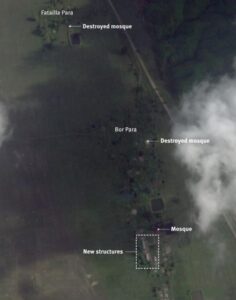
Geospatial & Satellite Analysis: Satellite imagery verified that the village of Hoyyar Siri was systematically burned to the ground and wiped off the map immediately after the AA took complete operational control of the area on May 2.
-
Exposing the Combatant Lie: The ULA claimed the casualties were entirely armed militia or junta forces. However, HRW’s geospatial analysis shattered this narrative: while one site (Bor Para) contained military equipment, the primary execution site in Fatailla Para showed human remains exclusively mixed with civilian clothing and zero military gear.
4. Ongoing Atrocities And Persistent Cruelfed
The cruelty of the Arakan Army did not end with the May 2 massacre. The report exposes an ongoing, predatory campaign against the displaced survivors:
-
Predatory Looting: Fleeing survivors were intercepted in nearby forests, forcefully stripped of their cash and jewelry, and physically beaten by AA fighters.
-
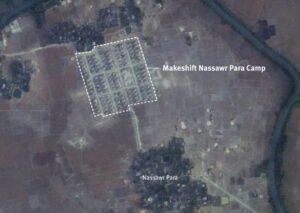
Forced Confinement (Nassawr Para Camp): The AA forcibly herded the survivors into a tightly monitored, makeshift internment camp in Nassawr Para. Refugees here are denied freedom of movement, stripped of basic medical care, and subjected to forced labor.
-
Coerced Propaganda: While holding them captive inside Rakhine State, the AA coerced and threatened survivors into filming scripted video testimonies to falsely clear the rebel group of civilian casualties.
-
Land Theft: While blocking the Rohingya from returning by falsely claiming the area is littered with landmines, satellite images reveal that the AA has built permanent infrastructure over the ruins of the village, including checkpoints and sheds to hold looted cattle.
5. Legal Classification: Arakan Army War Crimes
Human Rights Watch establishes that the Arakan Army’s leadership and command structure bear direct criminal responsibility for numerous severe violations of customary international law and Common Article 3 of the Geneva Conventions. These documented acts constitute egregious war crimes, including:
-
Deliberate targeting, hunting, and murder of unarmed civilians
-
Summary execution of captured persons in custody
-
Unlawful detention and arbitrary deprivation of liberty in internment camps
-
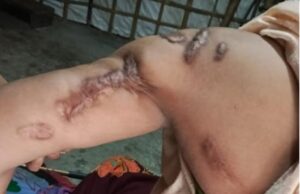
Outrages upon personal dignity, torture, and cruel treatment
-
Systemic arson, looting, and wholesale destruction of civilian property
-
Enforcement of collective punishment and illegal forced labor
6. Recommendations By HRW
Human Rights Watch concludes with an urgent call to the international community to recognize that the Arakan Army poses an active, deadly threat to the survival of the Rohingya population.
-
To the Arakan Army / ULA: Immediately cease all civilian attacks, dismantle the Nassawr Para detention camp, halt forced labor and child conscription, and hand over all documentation and forensic evidence of human remains to international investigators.
-
To United Nations Member States: Utilize international channels specifically the UN Human Rights Council’s 62nd session (June–July 2026) to apply immediate, targeted sanctions against the AA leadership hierarchy.
-
To the UN Security Council: Pass a binding resolution instituting a global arms embargo on Myanmar and formally refer the entire conflict to the International Criminal Court (ICC) to hold perpetrators accountable.