
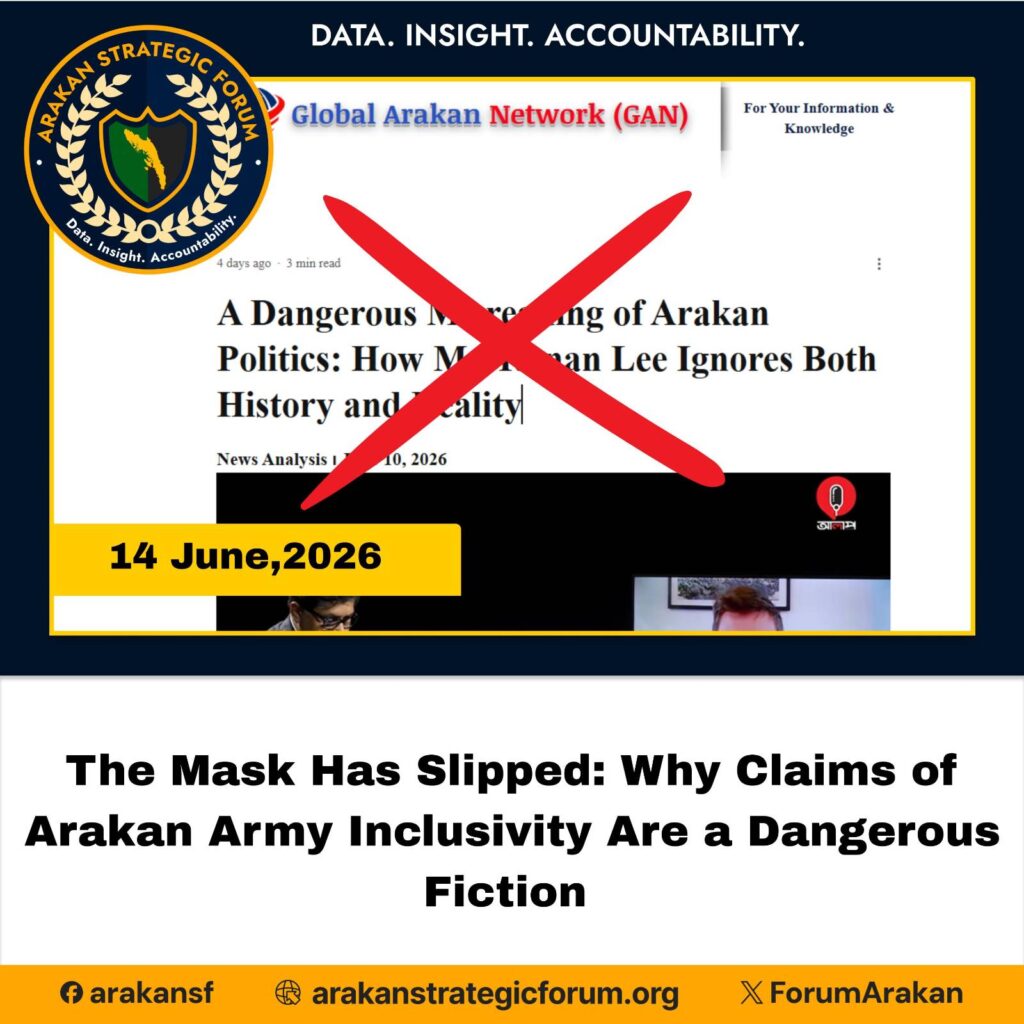
The Global Arakan Network’s recent article, “A Dangerous Misreading of Arakan Politics,” published on 10 June 2026, argues that the United League of Arakan and its armed wing, the Arakan Army, represent a largely secular, institutionally inclusive force committed to social cohesion.
It claims there have been “no communal clashes” under ULA rule, cites supposed thousands of Muslim officers in its administration, and dismisses any comparison between AA methods and those of the Myanmar junta as superficial or colonial. These assertions do not survive contact with documented reality.
Independent investigations tell a different story, one of deliberate mass killing, village destruction, forced labor, and the targeting of Rohingya civilians in areas the Arakan Army now controls. The evidence does not support a narrative of enlightened governance. It reveals a pattern of war crimes.
1. Hoyyar Siri, 2 May 2024: Civilians Shot While Waving White Flags
In Buthidaung Township, on 2 May 2024, Arakan Army fighters attacked Rohingya civilians fleeing clashes between advancing AA forces and junta positions. Human Rights Watch’s May 2026 investigation, based on 41 survivor and witness interviews plus satellite imagery, established that AA units stopped groups of Rohingya, separated them in paddy fields, and opened fire at close range.
Many villagers had raised white flags to signal they were non-combatants. One survivor stated plainly: “We hung white flags at the front of the procession to show that we were peaceful civilians evacuating to safety. It was not a battle. They were just shooting at people who were trying to run away.”
At least 170 Rohingya were killed, including a minimum of 90 children. The real figure is almost certainly higher; some monitors place it closer to 500. After the executions, AA fighters looted homes and systematically burned the village.
Satellite imagery confirms Hoyyar Siri was reduced to ash and remains uninhabitable. Two years later, survivors are still barred from returning and have received no justice or compensation. Additional abuses against those who escaped continue.
These acts, deliberate civilian targeting, summary execution, arson, and looting, constitute war crimes under international humanitarian law. Commanders who ordered or failed to prevent them bear individual criminal responsibility.
2. 5 August 2024: Mortars and Drones on Fleeing Civilians at the Naf River
Three months later the pattern repeated on a larger scale. As the Arakan Army pushed toward Maungdaw, thousands of Rohingya civilians fled their villages toward the Naf River, seeking to cross into Bangladesh. On 5 August 2024 they gathered on the riverbank near Maungdaw Cemetery.
From positions it controlled in nearby villages, the Arakan Army fired mortars and deployed drones against the crowded civilian gathering. Fortify Rights documented indiscriminate and disproportionate attacks that killed at least 150 to 200 Rohingya. It was the use of explosive weapons against a concentrated population of people trying to escape.
In the weeks before both massacres, the Arakan Army had already shelled, looted, and burned multiple Rohingya villages and hamlets east of Buthidaung. Satellite data recorded widespread fires across communities along the Mayu River in late April 2024. Displacement was not a byproduct of war. It was a method.
3. Forced Labor, Arbitrary Detention, and the Erasure of Identity
Beyond the mass killings, the Arakan Army has imposed forced labor on Rohingya civilians in areas under its control. Fortify Rights documented cases of Rohingya men, women, and children held in arbitrary detention ,some for up to a year and compelled to perform dangerous labor in support of military operations. These practices may themselves amount to war crimes.
Rohingya who remain face routine denial of their identity, often labeled “Bengali” by AA personnel, alongside severe restrictions on movement. These are not the actions of a force building inclusive institutions. They are the tactics of ethnic domination.
The Global Arakan Network’s run by AA’s chief brother portrayal of a secular administration with thousands of Muslim officers and zero communal violence collapses against this record.
Early statements from ULA figures about inclusion and merit-based appointments have given way, in practice, to repression once territorial control was secured. The Singapore-style cohesion model advertised in some quarters does not exist for the Rohingya population under AA authority.
4. The Same Logic, Different Uniforms
The junta’s long campaign of persecution, culminating in the 2017 ethnic cleansing widely recognized as genocide, remains unpunished. That history grants no armed group a free pass to commit fresh atrocities. Resistance to military rule does not confer immunity for the deliberate slaughter of civilians, the burning of villages, or the imposition of forced labor on a targeted ethnic community.
When an armed organization that claims to fight for the people of Arakan instead directs systematic violence against one of those peoples, the claim to moral or political legitimacy fractures. The evidence from Hoyyar Siri, the Naf River banks, and the burned villages of northern Rakhine is not ambiguous. It is forensic.
5. Accountability Cannot Be Selective
The international community, governments, and institutions that have investigated and condemned the junta’s crimes must apply identical standards to these documented violations.
The Arakan Army’s leadership should face investigation for war crimes and crimes against humanity. Survivors require protection, documentation support, and eventual conditions that allow safe return. Impunity for any perpetrator only guarantees the next cycle of violence.
The Rohingya have endured mass killing, displacement, and denial of existence for decades. They will not accept a new chapter written in the same blood by different hands. The facts are now on record. What follows is a test of whether the world will once again look away.
Rohingya Strategic Forum
June 2026