
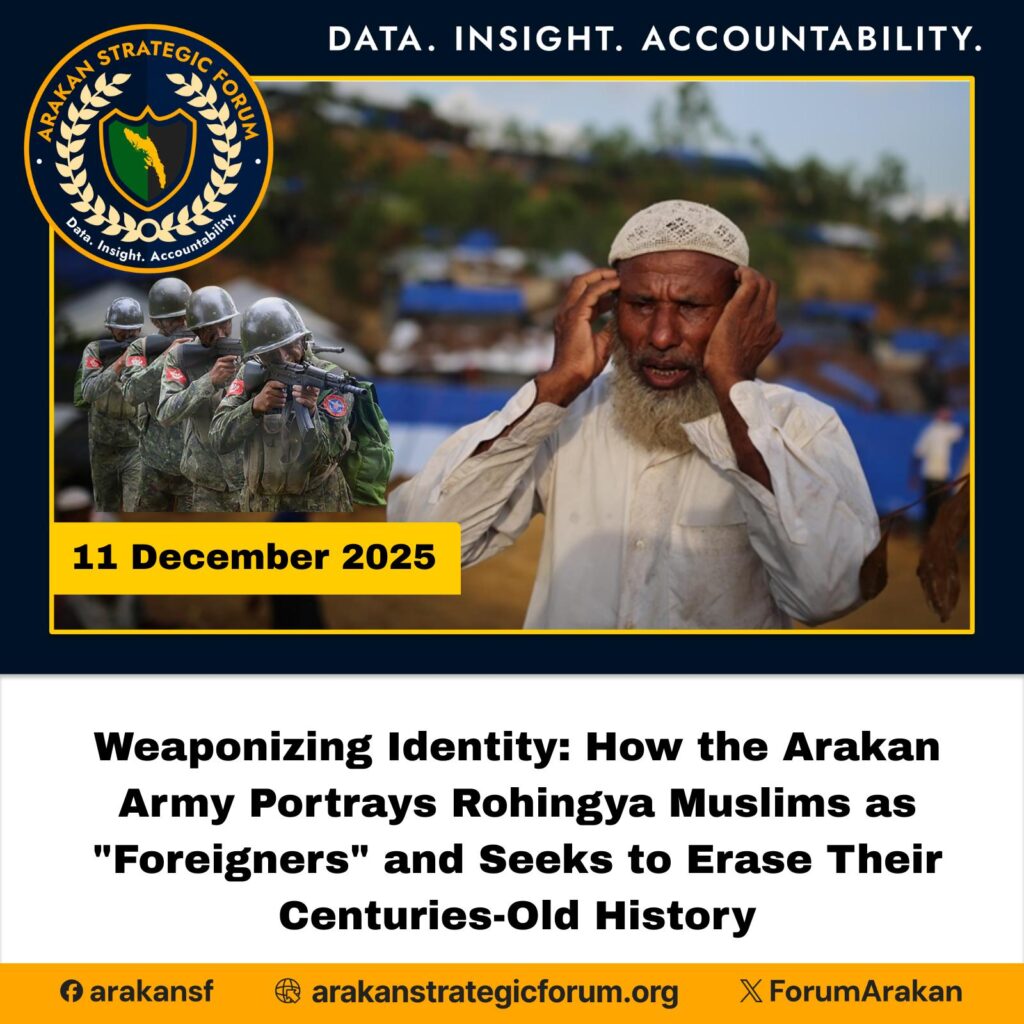
Across northern Arakan (Rakhine) State, the Arakan Army (AA) is pursuing a systematic campaign to redefine the Rohingya as foreign intruders rather than a people with centuries of documented presence. This is not rhetoric, it is a coordinated identity-erasure strategy woven into AA’s checkpoints, population controls, forced-labor systems, and propaganda.
As part of this identity manipulation, AA units deliberately avoid using the word Arakan and instead use alternative terms like Arakhha or Rakhine, because acknowledging “Arakan” would make it impossible for them to deny the centuries-old Rohingya Muslim history tied to that land. They understand clearly that they came from outside in recent generations, while the Rohingya did not so they alter language itself to obscure this truth.
AA field commanders and information units routinely push the narrative that Rohingya are “Bengali migrants,” a label used to justify surveillance, segregation, and coercion. This framing is reinforced through:
Identity-Control Mechanisms
AA’s travel permits, village block-lists, and population-registry demands force Rohingya to repeatedly “prove” their right to exist in their own land. Even basic activities fishing, farming, or visiting relatives require approval that can be denied arbitrarily.
Segregated Documentation
Villages are ordered to produce separate lists for “Rakhine” and “Rohingya,” erasing the latter’s indigenous identity and embedding the idea that they are outsiders. These lists are then used to target households for forced labor, extortion, or arrests.
Education & Cultural Suppression
Rohingya children face denial of schooling unless families comply with forced-labor quotas. Madrasas and community schools are shut down on the pretext of “security.” Local AA units have reportedly ordered the removal of Rohingya-language signage and have discouraged teaching Rohingya history a direct attempt to sever generational memory.
Forced Labor as Identity Punishment
AA commanders in Maungdaw and Buthidaung impose daily labor quotas 40–60 Rohingya per village regardless of harvest season, weather, or humanitarian conditions. Refusal triggers beatings, fines, eviction threats, or detention. Children as young as 10–13 are forcibly recruited to fill quotas.
Erasing Presence Through Displacement
Households unable to meet AA demands are threatened with removal, and many have had homes, land, and livestock seized. Forced displacement is then used to claim that “Rohingya are leaving because they are not from here,” reinforcing the fabricated foreigner narrative.
Leveraging Sea Flight as Propaganda
AA’s repression has pushed thousands to flee by sea toward Malaysia and Indonesia. Yet AA propaganda channels weaponize these departures to argue that “Rohingya have another homeland,” while concealing their own role in generating the exodus.
Psychological Warfare
By tying survival movement, work and food access to compliance with AA orders, the militia forces the Rohingya to internalize a dangerous message: your identity is conditional, and your history does not matter unless we allow it.
Strategic Objective
Depopulated Rohingya communities enable the AA to strengthen its drug-linked supply routes, build new bases, and shape a mono-ethnic political order. Reducing Rohingya presence is not collateral damage it is a cornerstone of the AA’s territorial project.
The result is clear
A coordinated effort to transform an indigenous community into a stateless population with no recognized past, no safe present, and no protected future.
This is neither genuine security nor legitimate administration. It is a calculated and systematic campaign aimed at dismantling the identity, presence, and historical continuity of the Rohingya people. At its core, it represents the deliberate erasure of Rohingya identity and history.